How do you stop staying up late after the kids go to bed?
Give the evening a fixed shape: close the day in a few minutes, take a protected stretch of time with a set end, then wind down before the phone ends up in bed with you. Most parents are not staying up because they are bad at sleep. They are staying up because 9 PM is the first moment all day that belongs to them.
Researchers have a name for it. Kroese and colleagues (Frontiers in Psychology, 2014) described bedtime procrastination as failing to go to bed at the time you intended when nothing outside you is stopping you, and found it predicted reports of not getting enough sleep. The CDC sleep guidance (checked November 2026) puts the target for adults aged 18 to 60 at 7 or more hours.
You do not need less me-time. You need me-time that ends.
Five evening mistakes parents make, and the fix for each
| The mistake | The fix |
|---|---|
| 1. Treating bed as the end of your free time. So you put it off, because going to bed means the day is over and you never got your turn. | Take your turn first. Give it a length (15, 30, 45 or 60 minutes) and an end time set before bedtime, not after. |
| 2. Carrying tomorrow to bed. The permission slip, the dentist call, the email to the school all start circling at 11:40 PM. | Write it down while you are still on the sofa. Pick at most three things for tomorrow and park the rest somewhere safe. |
| 3. Doing chores in your best hour. The kitchen expands to fill whatever time you give it. | Set a chore cut-off. The lunches can be made, the floor can wait. |
| 4. Winding down with the phone in your hand. "Just checking one thing" becomes an hour. | Switch to something that gets darker and quieter, then put the phone face down out of reach. |
| 5. Making the plan so strict it breaks on night two. One bad night and the streak is gone, so why bother. | Use a routine with no streak to lose. Miss a night, start again the next one. |
Each fix is small on purpose. A plan that takes forty minutes is just another reason to stay up.
How the four-minute evening reset works
We built Sleepward around those fixes. The listing calls it a four-minute evening reset, with three short optional steps you can skip or finish early.
- 01
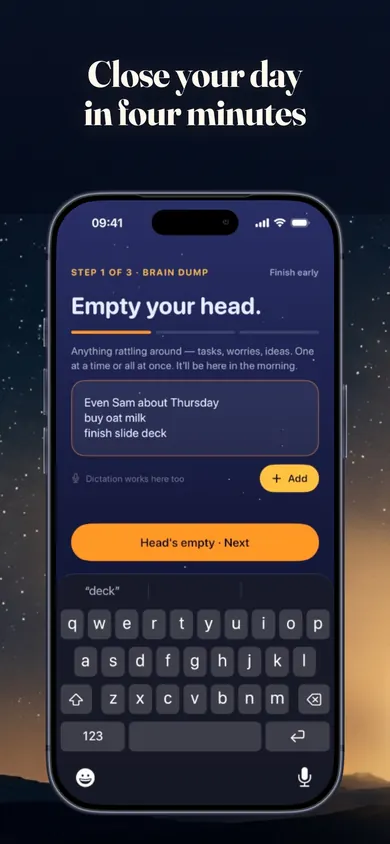
Empty your head
Brain Dump takes everything rattling around as separate entries you can edit later. Then pick up to three things for tomorrow: one main thing, one small task, one optional extra. Or none.
- 02
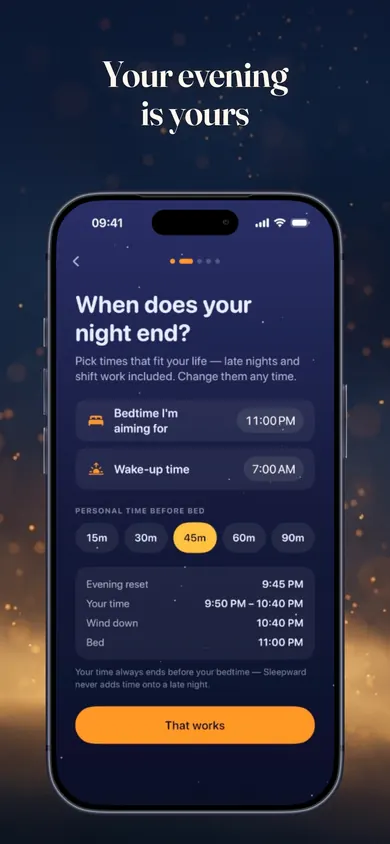
Take Your Hour
A protected stretch of personal time, 15 to 60 minutes or your own length. It always ends before the bedtime you set. The countdown is optional and you can close the app whenever you like.
- 03
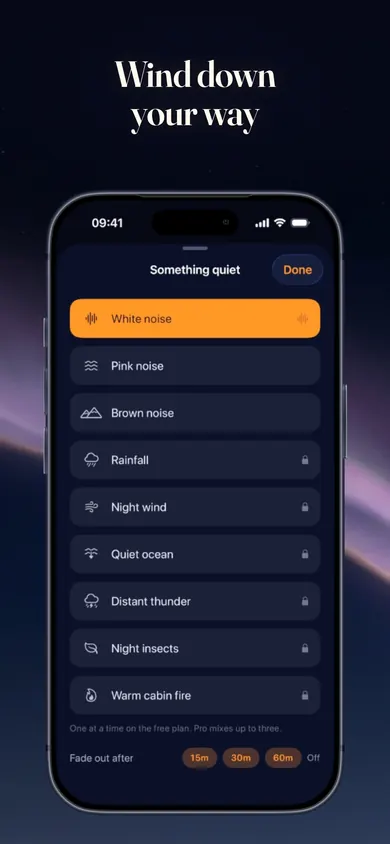
Wind down
A screen that gets gradually darker, a short routine you can edit (dim lights, read, prepare tomorrow's things) and free white, pink or brown noise with a fade-out timer. Then the phone goes down.
What the sorter above is showing you
The little list at the top is a model of one evening, not a feature of the app. It starts at 8:30 PM and adds up each block in the order you put it. Anything after "phone face down" never happens, because by then you are asleep. Try these two orders and compare:
The usual order
Chores, Your Hour, scroll in bed, a half-hearted wind-down, and the Brain Dump never happens. Lights out around 11:15 PM, and the to-do list is still in your head.
The Sleepward order
Chores, Brain Dump, Your Hour, wind down. Lights out around 10:09 PM, and the scrolling never starts because the phone is already face down.
Nothing in the second order is stricter. You still get 45 minutes for yourself. It just comes before the slide into the phone, not instead of sleep. On writing it down: a 2018 sleep-lab study in the Journal of Experimental Psychology: General found that 57 young adults who spent five minutes writing a specific to-do list at bedtime fell asleep faster than those who wrote about tasks already done. One small study, but a cheap habit to test.
Proof: the screens behind each fix


A Tuesday, told twice
Before. Bedtime stories end at 8:25. Dishes until 9:10. Sofa, phone, a show, the phone again. At 11:20 the brain remembers the swimming kit and the form that is due. Bed at 11:40, still scrolling at 12:30, alarm at 6:45.
After. Dishes stop at 9:05 even though the pan is still soaking. Four minutes on the sofa: swimming kit, form, call the dentist. Pick two of them for tomorrow. Forty-five minutes of the book, timer ending at 9:55. Screen goes dim, brown noise on, phone on the dresser. Asleep by 10:20.
That second evening is a composite we wrote, not a customer story, and it will not happen every night. Some nights a child wakes up and the whole plan goes. That is why Sleepward never breaks a chain: Grace Nights mean nothing resets when you miss one.
One design decision, one limit, and who should pick something else
- A decision we made: Sleepward never scores your sleep. You can log rough bed and wake times, or read sleep from Apple Health, but every number can be hidden. A score at 11 PM is one more thing to worry about.
- A limit: the wake-up reminder is a time-sensitive notification, not a system alarm. Silent mode or Focus can quiet it, so keep your Clock alarm.
- Pick something else if you want a sleep tracker with stages and scores, a white-noise app with dozens of sounds for free, or help with a sleep condition. Sleepward is a routine, and for persistent sleep problems a clinician is the right next step.
This is general information, not medical advice. Talk to your clinician.
Staying up late after bedtime: questions parents ask
Why do I stay up late after my kids go to bed?
Usually because the evening is the only time nobody needs anything from you, so going to bed feels like giving it up. Researchers call failing to go to bed at the time you intended, when nothing is stopping you, bedtime procrastination.
Is revenge bedtime procrastination a real thing?
The research term is bedtime procrastination, first described in a 2014 Frontiers in Psychology study of 177 adults. In that study it predicted reports of not getting enough sleep. The word revenge is popular shorthand for the feeling of taking time back.
How much sleep do parents need?
The CDC says adults aged 18 to 60 need 7 or more hours a night. Kids going to bed earlier does not change that number for you.
How do I get me-time without staying up late?
Give it a fixed length and a fixed end before you start. Sleepward's Your Hour does this: you pick 15, 30, 45 or 60 minutes or your own length, and it always ends before the bedtime you chose.
Does writing a to-do list before bed help?
One 2018 sleep-lab study of 57 young adults found people who spent five minutes writing a specific to-do list fell asleep faster than people who wrote about tasks they had already finished. It is one small study, but the habit is cheap to try.
Is Sleepward free?
The evening reset, Brain Dump, tomorrow's three things, Your Hour, wind-down, routines, Minimal Mode, sleep logs, white, pink and brown noise and the first world chapter are free. Sleepward Pro ($9.99 a month, $49.99 a year or $99.99 lifetime in the US) adds the other world chapters and studio soundscapes.
Will Sleepward fix my insomnia?
No. Sleepward is a routine and journaling tool, not a medical device, and it does not diagnose or treat any sleep condition. If sleep problems persist, talk to a clinician.
Close tonight in four minutes
The free version has everything on this page except the extra world chapters and studio sounds. Open Sleepward in the App Store, set your bedtime, and try one evening.

Updated November 2026
Related
- Sleepward: a bedtime routine app for night owlsA bedtime routine app for people who stay up late: a four-minute evening reset, a brain dump, your own hour, then wind down. Free on iPhone.
- Can't stop thinking about work at night?Pick the work thought that keeps you up and see where to park it before bed. Three short night stories, honest limits and a free four-minute reset.
- A bedtime routine for college students, night by nightTap your first class time and get tonight's dorm-proof plan, then a 7-night first week. Built on CDC sleep advice and student sleep studies.
- Revenge bedtime procrastination after long workdays: a checklistLong workday, home late, then up till 1 a.m. to feel human again. A sourced checklist and evening calculator for people who work long hours.