What do you do when you can't stop thinking about work at night?
Get each work thought out of your head and into a written next step before bed, then do something slower than your phone until you sleep. Thinking about work at night is normal. The trouble starts when the same replay runs for an hour with nowhere to land.
Not all work thinking is equal. a 2012 survey of 719 workers in the Journal of Occupational Health Psychology split it into two kinds. Affective rumination (replaying how a meeting felt, rehearsing a reply to a manager) was the strongest predictor of fatigue. Problem-solving pondering (working out what to do next) was not. So the aim is not to stop thinking. It is to turn the feeling into a step, write it down, and leave it there.
You cannot solve tomorrow at 11:48 PM. You can write down where you left it.
Honest limits first
Before the stories, here is what Sleepward cannot do, because a work-anxiety page that promises sleep is lying to you.
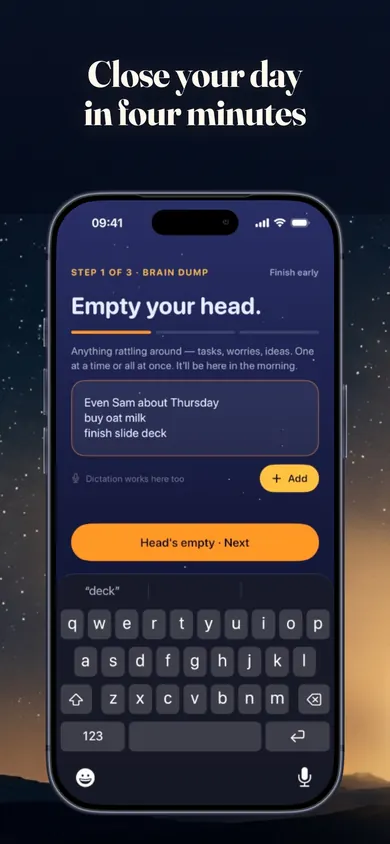
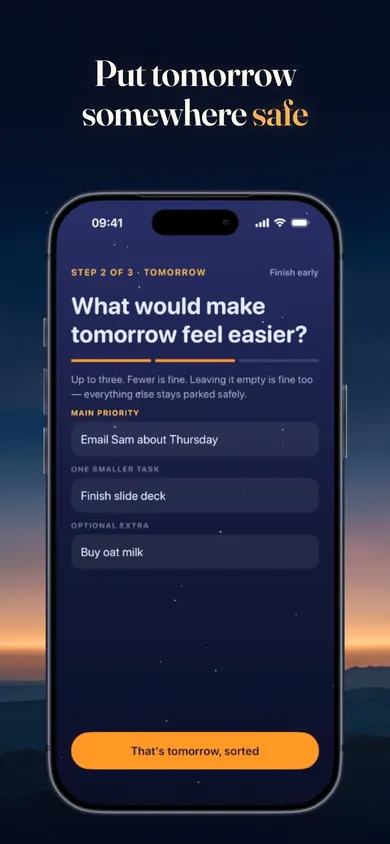
- It cannot switch thoughts off. It gives them a place: a private Brain Dump, then up to three things for tomorrow. The rest stays parked.
- It is not therapy or a medical device. It does not diagnose or treat insomnia or anxiety. If worry about work is wearing you down most nights, a clinician or your workplace support line is the right next step.
- The wake-up reminder is not an alarm. It is a time-sensitive notification that Silent mode or Focus can quiet. Keep your Clock alarm for the 7 AM meeting.
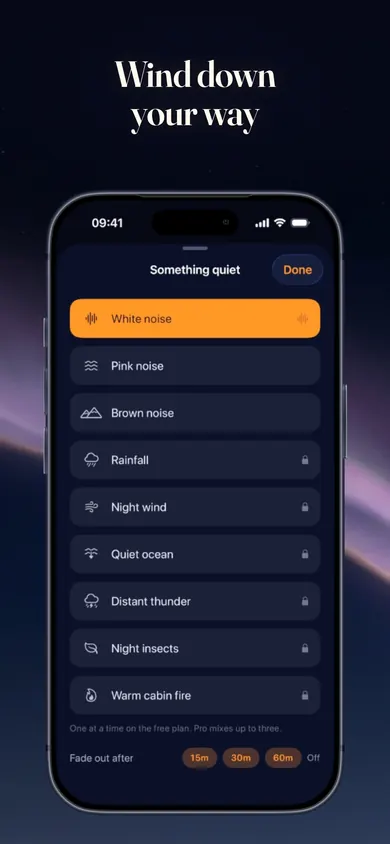
- Most of it is free, not all. The reset, Brain Dump, Your Hour, wind-down and three noise colours are free. Pro adds the other world chapters and eight studio soundscapes.
This is general information, not medical advice. Talk to your clinician.
Three nights of thinking about work at night, and how each one ended
These are composite evenings we wrote from the kinds of thoughts the quiz above lists. They are not customer stories.
Monday · 11:40 PM
The unsent email
A project manager remembers, teeth brushed, that the supplier never got the revised dates. She opens her laptop "just to send it", finds two more replies, and is still at the kitchen table at 12:30.
The parked version: at 9:45 she types one Brain Dump entry, "Email supplier the new dates, first thing", and makes it tomorrow's main thing. The laptop stays shut. The thought comes back at 11:40, and this time the answer is "already written down".
Wednesday · 12:15 AM
The meeting replay
A developer replays the stand-up where he got cut off. He drafts better comebacks in his head. None of this is a task; it is a feeling, the affective kind the 2012 study linked to tiredness.
The parked version: he writes it as it is, "Annoyed about stand-up", and does not pick it for tomorrow. Writing the feeling down is the whole job. Then Your Hour: 30 minutes of a game that ends at 10:30, before the bedtime he set.
Sunday · 10:50 PM
Everything at once
The Sunday dread: the whole week arrives as one blur. Nothing is specific enough to act on, which is why it will not go away.
The parked version: six quick entries in the Brain Dump, one for each lump. Then three picks: one main thing, one small task, one optional extra. Three are on Monday's list; the others wait, parked safely. Brown noise, fade-out timer at 30 minutes, phone on the dresser.
The same pattern sits under all three: a thought that is a task becomes a next step; a thought that is a feeling gets written once and left. On the writing part, a 2018 sleep-lab study of 57 young adults (Journal of Experimental Psychology: General) found people who wrote a specific to-do list for five minutes at bedtime fell asleep faster than people who wrote about finished tasks. One small study, but the same move.
Who this is not for
Pick something else if any of these sounds like you:
- You want a sleep score, sleep stages or a smart alarm. Sleepward never scores your sleep.
- Your mind races at night for reasons beyond a busy job, or you have not slept well for weeks. Start with a clinician, not an app.
- You need your work to-do list synced with your team. Sleepward's notes stay on your iPhone and are never uploaded, so it is a personal parking spot, not a project tool.
The NHS Every Mind Matters sleep advice (checked November 2026) lists the basics worth doing first: a regular routine, time to relax before bed, and putting your phone away. The CDC target is 7 or more hours for adults 18 to 60, per the CDC (checked November 2026).
Thinking about work before sleep: three ways to park it
| Notes app | Paper by the bed | Sleepward reset |
|---|
| Cost | Free | Free | Free core; Pro optional |
|---|
| Limits tomorrow to 3 things | No | Only if you do | Yes: main, small, optional extra |
|---|
| Pulls you back into email | Often, it sits next to Mail | No | No; notes stay on device |
|---|
| Ends with a wind-down | No | No | Darkening screen, routine, noise |
|---|
| Works with the lights off | Bright screen | Needs a lamp | Dark screen; still a phone |
|---|
Paper by the bed is a good answer. We built Sleepward for the people whose paper ends up under a mug.
One design decision: the reset is three steps and you can skip or finish early on any of them. We tested longer versions and they turned into one more job at the end of a long day.
Questions about work thoughts at bedtime
Why can't I stop thinking about work when I go to bed?
Bed is often the first quiet moment of the day, so unfinished tasks and replayed conversations get your full attention. Researchers call it work-related rumination. A 2012 survey of 719 workers found the emotional kind, replaying how something felt, was the type most linked to tiredness.
Is it bad to think about work before sleep?
Not all of it. In the same 2012 study, problem-solving thinking (working out a next step) was not linked to more fatigue, while affective rumination was. The useful move is to turn the thought into a written next step, then stop.
Does writing a to-do list before bed help you sleep?
In one 2018 sleep-lab study of 57 young adults, people who spent five minutes writing a specific to-do list fell asleep faster than people who wrote about tasks they had finished. It is one small study, but the habit costs nothing to try.
What should I do if I wake up at 3 AM thinking about work?
Write the thought down in a word or two so it is safe, then go back to your wind-down rather than solving it. If waking at night is regular and affects your days, talk to a clinician.
Can an app stop me thinking about work?
No app can switch thoughts off. Sleepward gives the thoughts a place to go: a Brain Dump, up to three things for tomorrow, and a wind-down screen that gets darker. It does not diagnose or treat insomnia.
Is Sleepward free?
The evening reset, Brain Dump, tomorrow's three things, Your Hour, wind-down, Minimal Mode, sleep logs and white, pink and brown noise are free forever. Sleepward Pro ($9.99 a month, $49.99 a year or $99.99 lifetime in the US) adds the other 12 world chapters and studio soundscapes.
Leave work at the Brain Dump tonight
Four minutes, three optional steps, no sleep score. Download free on the App Store and try it once before your next 11 PM replay.

Updated November 2026