Should you get out of bed if you can't sleep?
Yes: if you're still awake after about 20 minutes, get up, sit somewhere comfortable and do something relaxing, then go back to bed when you feel sleepy. Two major health sources give that same 20-minute point (NHS Every Mind Matters (2026); Mayo Clinic (2025)), and the NIH NHLBI (2022) describes getting out of bed when you can't sleep as part of stimulus control, a standard insomnia treatment.
The bed is for sleeping. Lying there wide awake teaches it the wrong job.
Who this advice and Sleepward are not for
- Anyone with long-running trouble: if you've had poor sleep for months, or it's hard to cope by day, see a GP (NHS (2024)). Sleepward does not diagnose or treat insomnia or any sleep condition.
- People with loud snoring or pauses in breathing at night. That needs a clinician, not a routine.
- Anyone who wants a sleep score. Sleepward never scores your sleep.
- Android users. Sleepward is iPhone only.
What your quiz answer was built from
Every line the quiz can give you comes from one of six sources, dated in the table above. The 20-minute point is from NHS and Mayo Clinic. Keeping the clock out of view and the phone face down is from NHS Every Mind Matters. The to-do list line is from a 2018 sleep-lab study: 57 young adults who wrote a specific to-do list for five minutes at bedtime fell asleep faster than those who wrote about tasks already done (Scullin et al., J Exp Psychol Gen (2018)). And stimulus control, the idea under all of it, is suggested as a single-component therapy for chronic insomnia in the American Academy of Sleep Medicine guideline, J Clin Sleep Med (2021).
Notice what the sources don't say: none promises a number of minutes until sleep, and none says one bad night is a problem. Most of the advice is about the next twenty minutes, not the whole night.
The 20-minute rule with Sleepward, in 3 steps
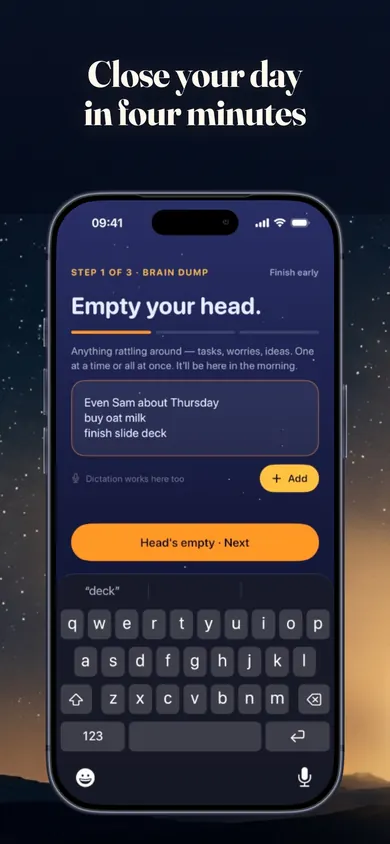
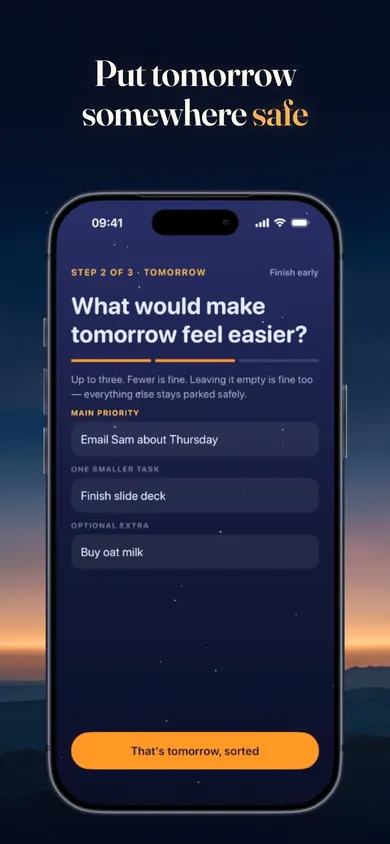
- Before bed, empty your head. Brain Dump takes everything rattling around as separate entries. Then pick up to three things for tomorrow, or none.
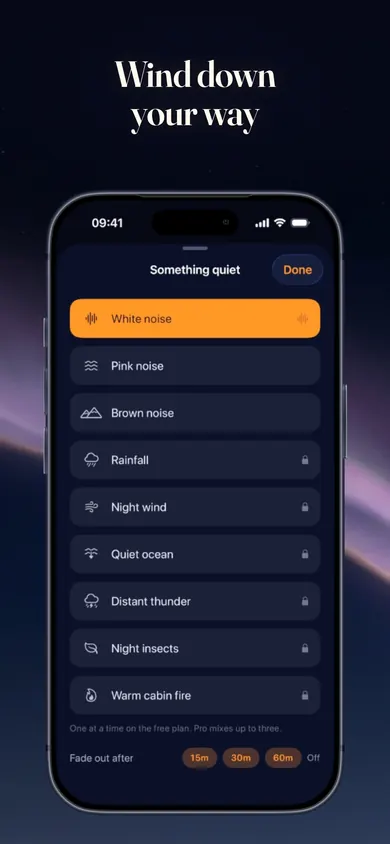
- Wind down. A darkening wind-down screen, a routine you can edit and free white, pink and brown noise with a fade-out timer.
- If you're up at 2 AM, your list is already parked. Sit somewhere comfortable, keep the lights low, and go back when sleepy.
Honest limits
Sleepward is a personal routine and journaling tool, not a medical device. It won't tell you when 20 minutes have passed in bed, by design: we didn't want a phone lighting up to report how long you've been awake. Free forever covers the evening reset, Brain Dump, tomorrow's three things, Your Hour, wind-down, routines, Minimal Mode, sleep logs, white, pink and brown noise and the first world chapter. Sleepward Pro ($9.99/month, $49.99/year with a 7-day trial for eligible new subscribers, or $99.99 lifetime) adds all 13 world chapters and 8 studio soundscapes with a mixer.
The optional wake-up reminder is a notification, not a system alarm; keep your Clock alarm for anything important. This is general information, not medical advice. Talk to your clinician.
Lying there vs getting up
Stay in bed, eyes on the clock
Minutes get counted, the bed gets linked with being awake, and the phone light comes on every time you check.
Get up after about 20 minutes
Sit somewhere comfortable, do something relaxing, return when sleepy. The approach NHS, Mayo Clinic and NIH describe.
Inside Sleepward
Can't sleep? Common questions
Should I get out of bed if I can't sleep?
Yes, according to the major health sources. NHS Every Mind Matters (2026) says if you're still awake after around 20 minutes, get up and sit somewhere comfortable, then go back to bed when you feel sleepy. Mayo Clinic (2025) gives the same 20-minute point.
What is the 20-minute rule for sleep?
It is a simple version of stimulus control: if you haven't fallen asleep after about 20 minutes, leave the bed and do something relaxing until you feel sleepy (Mayo Clinic (2025)). The aim is to link your bed with sleeping rather than lying awake (NIH NHLBI (2022)).
How do I know 20 minutes have passed without watching the clock?
Estimate. NHS Every Mind Matters (2026) suggests keeping clocks out of view and your phone face down. If it feels like a long time and you're getting more awake, that is your cue.
What should I do when I get up?
Something relaxing in a comfortable spot, then back to bed when sleepy (NHS Every Mind Matters (2026), Mayo Clinic (2025)). If your mind is on tomorrow's tasks, a five-minute, specific to-do list helped people fall asleep faster in one sleep-lab study (Scullin et al., J Exp Psychol Gen (2018)).
Is it bad to lie in bed awake?
Occasionally, no. But treatment guidance for insomnia includes getting out of bed if you can't sleep and using the bed only for sleep, so the bed stays linked with sleeping (NIH NHLBI (2022)).
When should I see a doctor about not sleeping?
NHS (2024) says to see a GP if changing your sleeping habits hasn't helped, you've had trouble sleeping for months, or it's affecting your daily life so it's hard to cope. Insomnia lasting 3 months or longer is called long-term insomnia.
Download free on the App Store
Set up tonight's four-minute reset so tomorrow's list isn't the thing keeping you up.

Related
- Sleepward: a bedtime routine app for night owlsA bedtime routine app for people who stay up late: a four-minute evening reset, a brain dump, your own hour, then wind down. Free on iPhone.
- A bedtime routine for adults with ADHDA bedtime routine for adults with ADHD that fits a wandering evening: a live countdown to bed, a 4-minute reset, and what the research says.
- A bedtime routine for college students, night by nightTap your first class time and get tonight's dorm-proof plan, then a 7-night first week. Built on CDC sleep advice and student sleep studies.
- Can't stop thinking about work at night?Pick the work thought that keeps you up and see where to park it before bed. Three short night stories, honest limits and a free four-minute reset.