How do you fix your sleep schedule after winter break?
Pick one wake-up time, keep it every day, and walk your bedtime back to it in small steps over the nights you have left, with a short routine that tells the evening it is over. Light is the strongest cue your body clock gets, according to the NIH's National Institute of General Medical Sciences (updated 2025), so morning light and dim evenings do a lot of the work.
Researchers even have a name for the gap between the sleep you keep on free days and the sleep your schedule asks for: a 2006 paper in Chronobiology International called it social jetlag. Two weeks of break is a long trip in that sense. The good news is that you get to choose how fast you fly home.
The reset in three steps
The short version: anchor the morning, shrink the evening, end it on purpose.
- Anchor the wake time. Set the alarm for the time you will need on the first school or work day, or as close as you can stand, and keep it, weekends included. That is Mayo Clinic (2025)'s first tip: same bedtime and wake time every day.
- Move lights-out in small steps. A three-hour jump in one night rarely works. Use the flowchart below to spread the change across the nights you have, and skip long naps; Mayo Clinic suggests one hour at most, and not late in the day.
- Give the evening a visible ending. Late nights over break are often about wanting more evening, not about being unable to sleep. A fixed, short routine makes stopping a decision you make once, not ten times.
Decision flowchart: your night-by-night reset plan
Four taps. It prints a dated plan you can follow from tonight. Nothing is saved or sent.
This is general information, not medical advice. Talk to your clinician if sleep stays hard.
A reset night, minute by minute
What one night of the plan looks like when it goes right.
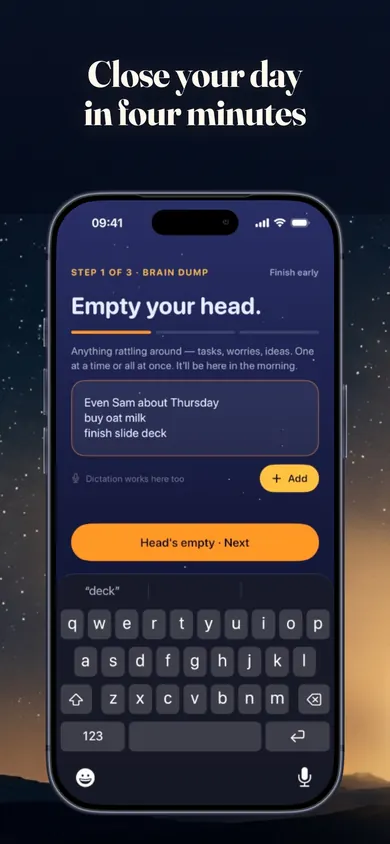
You open Sleepward instead of the next episode. Step one is the Brain Dump: the email you owe, the bus pass you need to top up, the thing someone said at dinner. Each goes in as its own entry. Two minutes.
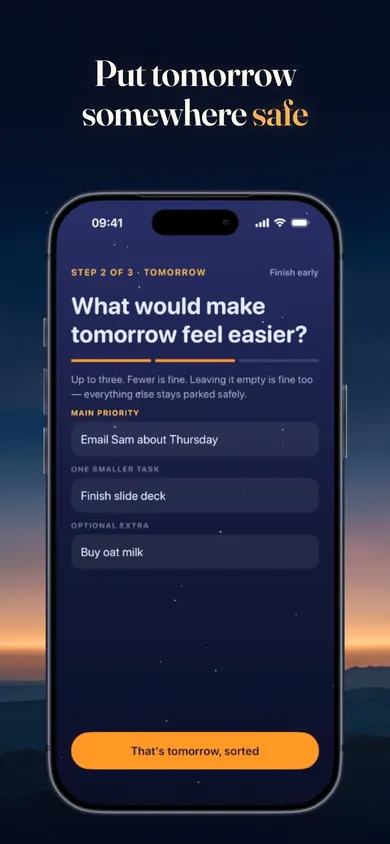
Tomorrow's three: one main thing (get to the 8:30 start on time), one small task (pack the bag tonight), one optional extra. You leave the extra empty. That is allowed.
Your Hour starts, set to 45 minutes. You finish the episode after all, guilt-free, because this time it has an end that sits before the bedtime you chose.
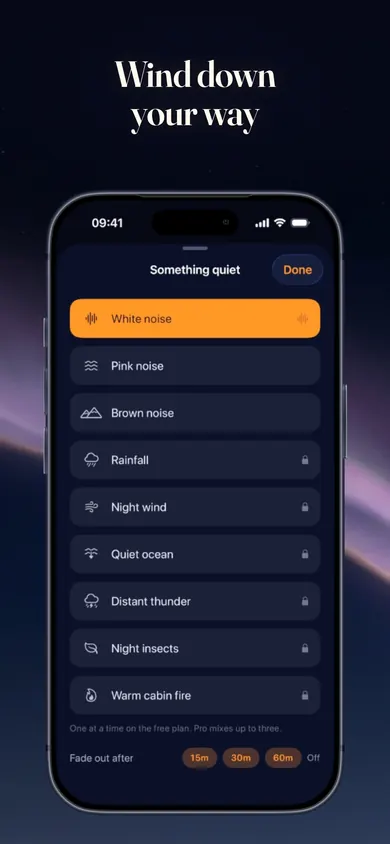
The wind-down screen darkens. Brown noise on, fade-out timer at 30 minutes. Phone face down on the nightstand.
The Clock app alarm, not Sleepward, wakes you. A one-tap morning check-in with four faces, or skip it. The plan holds for one more night.
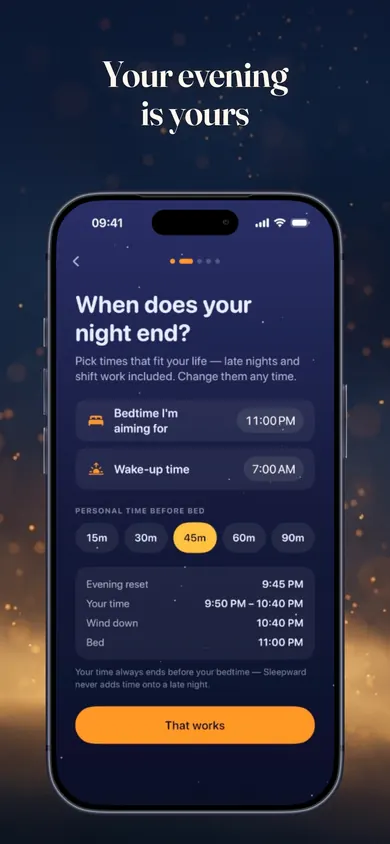
What the Sleepward screens actually show
Store screenshots, tinted to match this page. Tap through on the App Store for full colour.
Honest limits, and who should pick something else
- We made one choice on purpose: Sleepward never scores your sleep and never breaks a streak. If you want a sleep score or snore recording, a tracker app will suit you better.
- The wake-up reminder is not an alarm. It is a time-sensitive notification that Silent mode or Focus can quiet. Keep your Clock alarm for the first day back.
- It cannot make you put the phone down. If you need apps physically locked at 11 p.m., pair it with Screen Time Downtime or an app blocker.
- Free versus Pro: the whole reset in this plan is free. Pro adds the other 12 world chapters, the Chronicle book and studio soundscapes like rain and ocean.
Sleep schedule after the holidays: common questions
How long does it take to fix a sleep schedule after the holidays?
It depends on how far it drifted and how many nights you have. Moving in small steps over several nights tends to feel easier than one big jump the night before your first alarm. There is no official number of minutes per night; the flowchart above uses small steps because they are easier to keep.
Should I pull an all-nighter to reset my sleep schedule?
We would not. You start the first school or work day short on sleep, and a long afternoon nap afterwards can push bedtime late again. Mayo Clinic suggests keeping naps to an hour at most and not napping late in the day.
Is it better to fix my bedtime or my wake time first?
Wake time. You can choose when your alarm rings; you cannot order yourself to fall asleep. Mayo Clinic's advice is the same bed and wake time every day, weekends included, and morning light helps because light is the strongest cue for your body clock, according to the NIH.
What if I go to bed early and just lie there awake?
Mayo Clinic suggests that if you are not asleep after about 20 minutes, you get up, do something relaxing, and go back to bed when you feel tired, while keeping your usual wake time.
Does Sleepward move my body clock for me?
No. Sleepward is a routine and journaling app, not a medical device. It gives the evening a clear ending: a four-minute reset, protected personal time that always ends before your bedtime, and a wind-down. You still have to put the phone down.
Is Sleepward free?
The evening reset, Brain Dump, tomorrow's three things, Your Hour, wind-down, white, pink and brown noise, sleep logs and the first world chapter are free forever. Sleepward Pro ($9.99 a month, $49.99 a year or $99.99 lifetime in the US) adds 12 more world chapters and studio soundscapes.
When should I talk to someone about my sleep?
If you still cannot fall asleep or stay asleep weeks after break, or daytime sleepiness is getting in the way, talk to your clinician or student health service. This is general information, not medical advice.
Try it tonight
Four minutes to close the day, then an evening that ends before your bedtime. Start it a few nights before the first alarm of 2027.

Sleepward on the App Store · free, no account · Updated November 2026
Related
- Sleepward: a bedtime routine app for night owlsA bedtime routine app for people who stay up late: a four-minute evening reset, a brain dump, your own hour, then wind down. Free on iPhone.
- A bedtime routine for adults with ADHDA bedtime routine for adults with ADHD that fits a wandering evening: a live countdown to bed, a 4-minute reset, and what the research says.
- A bedtime routine for college students, night by nightTap your first class time and get tonight's dorm-proof plan, then a 7-night first week. Built on CDC sleep advice and student sleep studies.
- Free bedtime routine app: six options checked against their listingsWhich bedtime routine app is actually free? We read six App Store listings in November 2026. Take a 3-tap quiz, then see what each one charges.