For women who left an appointment feeling rushed: build a one-page symptom summary in five steps.
0/5
Tap each part you already have. The ring shows how ready your page is.
Free on iPhone and iPad
What should a menopause symptom summary for your doctor include?
A good menopause symptom summary fits on one page: your main concern, a short timeline, how often and how badly symptoms happen, your medicines and supplements with doses, and your top three questions, most important first. It is not a diary. It is the part of the diary your clinician can read in the first minute.
Updated November 2026
Who this guide is not for
Urgent symptoms. Heavy or unexpected bleeding, chest pain or feeling unsafe need care now, not a better summary.
People who love long diaries. If a daily journal helps you, keep it. This page is about the one-page extract you hand over.
Anyone hoping for a diagnosis. A summary organizes what you noticed. Your clinician does the diagnosing.
How the one-page summary works, in 3 steps
Collect notes for two to four weeks, whenever something is worth remembering.
Pick the five parts below and leave the rest out.
Hand over the page at the start of the visit, not the end.
The 5 steps, one panel each
Each panel shows what to write, an example line, and why it earns a place on the page.
1
Lead with one main concern
One sentence, at the very top, about the thing that most affects your life right now.
“Night sweats wake me about four nights a week and I’m struggling at work.”
Doctors read the top of a page first. If the main concern is item seven, it may never get discussed.
2
Add a short timeline
When it started, and what changed since: periods, sleep, mood, treatments.
“Since March. Periods every 5 to 9 weeks since spring. Started HRT patch in August.”
Mayo Clinic (2026) suggests keeping a journal of your menstrual cycles for the past few months before an appointment.
3
Show how often and how bad
Numbers beat adjectives. A count and a 1 to 3 strength rating is plenty.
“Hot flashes: 5 to 8 a day, mostly strength 2. Broken sleep: 11 of the last 14 nights.”
Mayo Clinic (2026) suggests a log of how often symptoms happen and how severe they are.
4
List medicines and supplements, with doses
Everything you take, including the things you buy without a prescription.
“Estradiol patch, [my dose], twice weekly; magnesium, [dose], at night; ibuprofen as needed.”
Mayo Clinic (2026) lists medicines, herbs and supplements with their doses among the things to bring.
5
End with your top three questions
Most important first, so the one you care about is not the one that gets squeezed out.
“1. Could the night sweats be the patch dose? 2. Is my sleep worth a separate plan? 3. Do I need any tests?”
Mayo Clinic (2026) suggests writing questions down with the most important first, and bringing a friend or family member if possible.
The whole guide in one line: lead with what matters, back it with numbers, end with questions.
Copy-ready template
MY MENOPAUSE SUMMARY            Date: ________
Main concern (one sentence):

Timeline (when it started, what changed):

How often and how bad (counts, 1-3 strength):

Medicines and supplements (with doses):

What I have tried and what happened:

My top 3 questions (most important first):
1.
2.
3.
The same five steps in My Midlife Story
We make My Midlife Story, so read this as our pitch, with store screenshots and honest captions.
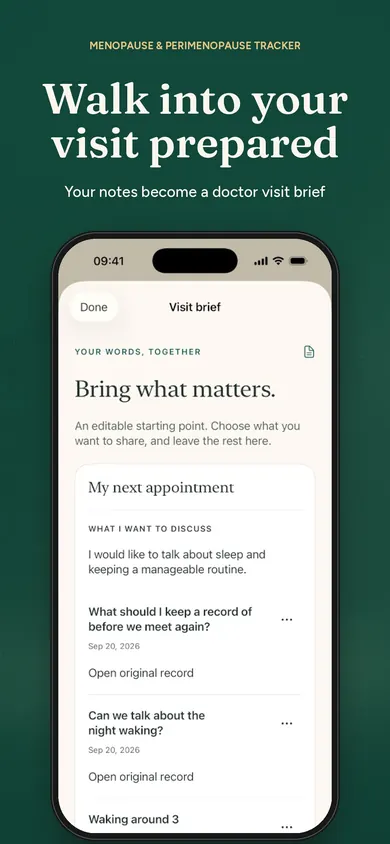
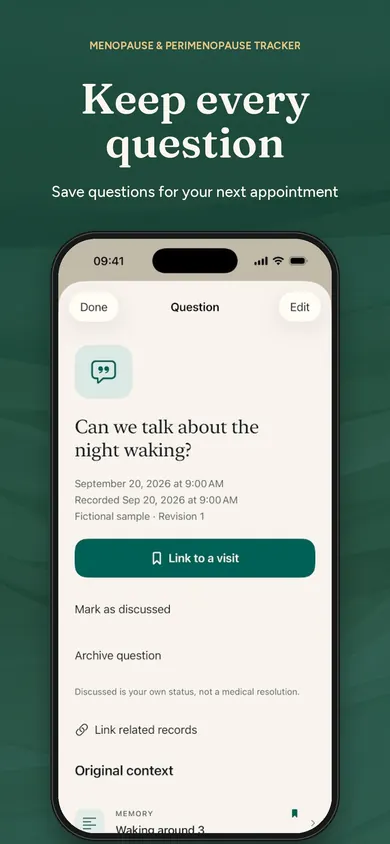
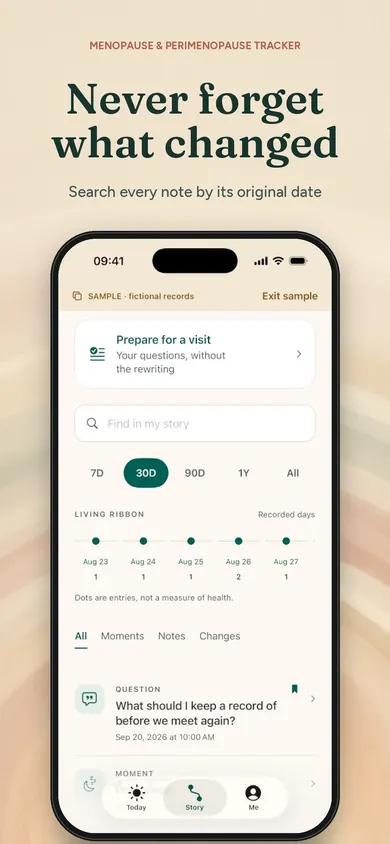
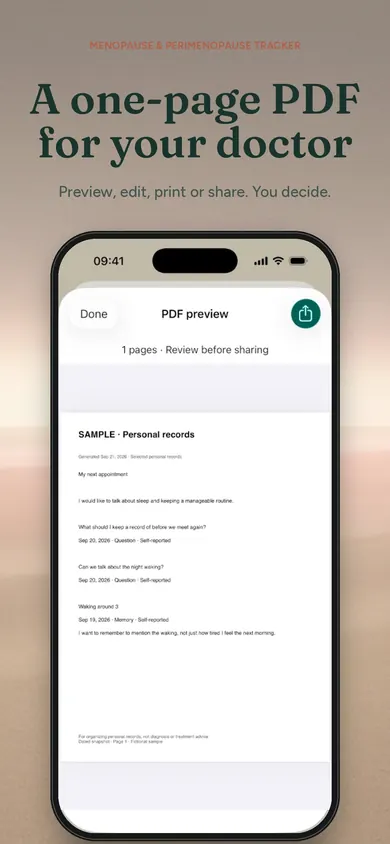
Visit brief: main concern, questions, chosen notes.Questions saved the moment you think of them.Find notes by date for the timeline.Preview, edit, print or share the one-page PDF.
Memory, notes app, or visit brief?
From memory
Notes app
My Midlife Story
Dates
Guessed
If you typed them
Saved with every note
Main concern first
Depends on the day
If you reorder
Chosen when you build the brief
One page to hand over
No
Copy and paste
Editable brief, PDF, print
Cost
Free
Free
Free core; optional Premium
Honest limit: Premium adds comparisons between periods, grouped Replays, advanced visit briefs and Playbooks. The basic brief and PDF are free, and for most people that is enough. If your clinic already runs a symptom questionnaire you like, use it; this is a complement, not a replacement.
Questions about menopause appointments
What should I bring to a menopause appointment?
A short symptom log (how often, how severe), a record of your periods for the past few months, a full list of medicines and supplements with doses, and your questions written down with the most important first. That list comes from Mayo Clinic (2026).
How do I explain menopause symptoms to my doctor?
Start with the one symptom that affects your life most, give a number for how often it happens, then say what you want from the visit. “I want to talk about treatment options for night sweats” is clearer than “I just feel off.”
What if my doctor dismisses my symptoms?
Bring the summary, ask that your concerns be noted in your record, and ask what the next step would be if things do not improve. You can also ask for a second opinion or for a clinician with a special interest in menopause.
How long do menopause symptoms last?
The NHS (2026) says symptoms usually last 7 to 9 years, sometimes longer, and can change over that time. That is one reason a dated summary is more useful than a memory of last month.
When is menopause official?
The WHO menopause fact sheet (2024) says natural menopause is deemed to have occurred after 12 consecutive months without a period, generally between ages 45 and 55. Before that, changes are part of perimenopause.
Does My Midlife Story make the summary for me?
It builds an editable one-page visit brief from what you choose: a main concern, up to three questions and the notes you want to share. You preview it, edit it, and save, print or share the PDF only when you decide. Visit briefs and PDF export are free.
This is general information, not medical advice. Talk to your clinician.
A mini story: ten minutes, used well
Her last appointment ended with “let’s see how you go.” She had mentioned sleep, then mood, then the hot flashes, in that order, and ran out of time before the question she actually cared about.
This time she handed over one page before sitting down. Main concern at the top: broken sleep, 11 of 14 nights. Underneath, a timeline, two medicines with doses, and three questions. The first question got answered. So did the second. The average age of menopause in the United States is 52, according to the National Institute on Aging (2024); she was 49, and the page helped her say clearly that this was the transition, not just a stressful year.
Get My Midlife Story free
Log a symptom in one tap, keep every question, and turn the notes you choose into a one-page visit brief. Private, no account, no ads.