How do you catch up on water intake?
Spread what is left over the hours until bed in small, regular drinks, about a cup at a time, instead of chugging it all at once; if the gap is too big, drink what you comfortably can and start fresh tomorrow. Your body does not keep a ledger that has to balance by midnight.
Updated November 2026
A mini story: the 3:40 p.m. bottle
A full bottle, still sealed, at 3:40 in the afternoon. Back-to-back calls, a sandwich at the desk, a coffee that went cold. The goal is 64 oz and the honest total is one mug.
The tempting fix is to stand at the sink and down a liter. It feels productive and mostly gets you a sloshy stomach and three bathroom trips during the 4:30 meeting. The better fix is boring: one cup now, one cup an hour, a glass with dinner, and nothing big after 9:30.
That is what the tool above does. It counts what is left, spreads it across the hours you have, caps each hour, and tells you plainly when tonight is not the night to finish.
Your catch-up schedule
This updates as you change the numbers at the top. Times are rounded; treat them as a rhythm, not alarms.
How the tool decides
- One cup per drink. Each slot is 8 oz or 250 mL, a normal glass or mug.
- An hourly cap of 16 oz (500 mL). Well under the general ceiling of 6 cups per hour that CDC NIOSH (2026) gives even for workers sweating in heat.
- A one-hour buffer before bed. NHS advice on waking at night to pee (Oxford Health, 2025) suggests reducing fluid in the evening if you wake at night to pee.
- Leftovers roll off. If the gap will not fit safely, the tool says so instead of squeezing it in.
The rule in one line: a cup an hour beats a liter at once.
Who this tool is not for
- Anyone on a fluid limit from a clinician, including some heart and kidney conditions. Use their number.
- Athletes after long, sweaty sessions. Replacing big sweat losses can involve electrolytes too; this tool only paces plain fluid.
- People who are unwell. Vomiting, diarrhea, fever or signs of dehydration call for medical advice, not a schedule.
Catch-up questions
Can you catch up on water intake at night?
Partly. Spread what you can over the hours left in small drinks, and stop a while before bed. NHS advice on waking at night to pee (Oxford Health, 2025) suggests reducing fluid in the evening and cutting back on caffeine if night-time bathroom trips wake you.
Is it bad to drink a lot of water at once?
For most healthy adults one big glass is fine, but downing liters fast is not a fix. Mayo Clinic explains that too much water can drop blood sodium dangerously low, and CDC NIOSH (2026) says that even for workers sweating in heat, fluid generally should not exceed 6 cups per hour.
How much water should I drink per hour to catch up?
Our tool caps the plan at 16 oz (500 mL) an hour, well under the 6 cups per hour CDC NIOSH sets as a general ceiling for workers in heat. Most hours it schedules a single cup.
What if I can't reach my water goal today?
Let it go. Log what you drank, start tomorrow on time, and treat today as data: what pushed water out of your morning? A missed goal is not a debt you have to repay tonight.
Do coffee and tea count when catching up?
Yes. NHS (2023) says tea and coffee count toward daily fluid, and Mayo Clinic (2026) agrees. In the evening, decaf or caffeine-free options are kinder to your sleep.
How does Dropkin stop this happening again?
Reminders arrive only during your wake hours, wait after each drink, stay quiet when you are on pace and stop at your goal. Hydration Pace shows On pace or A little behind, so you see the gap at 11 a.m. instead of 9 p.m.
Is the pacing tool free?
Yes, it runs in your browser with no sign-up and saves nothing. Dropkin itself is free too, with optional Pro for extra worlds, styles and longer history.
This is general information, not medical advice. Talk to your clinician.
Honest limits
The tool does not know your body, your weather or your health. It divides a number you choose. Food also supplies water (about 20% of your day, according to Mayo Clinic (2026)), and the tool ignores it, so the real gap is often smaller than it looks.
Dropkin has the same honesty built in. You set the goal; it does not calculate your needs, and it is not a medical device. Extra water past your goal earns nothing in the app, so there is never a reason to overdo it. That was a deliberate choice on our part.
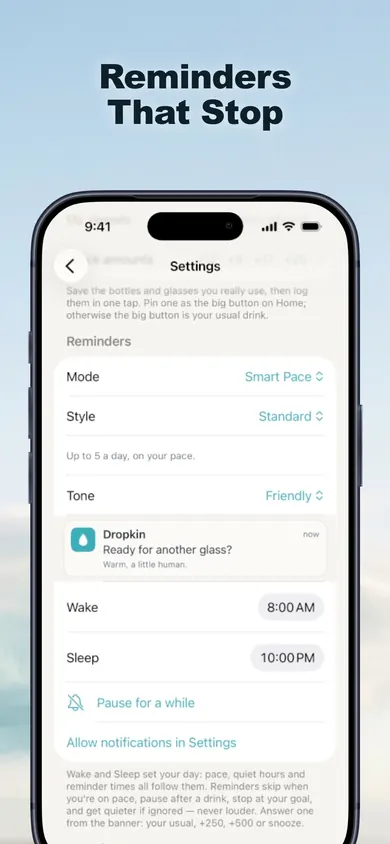
Free covers unlimited logging, saved vessels, reminders, Hydration Pace, widgets, Apple Watch and 30-day history. Pro adds all four worlds, 23 Pro styles, saved Looks and longer history.
Catch the gap at 11 a.m., not 9 p.m.
Save your bottle once, log it in one tap, and let Hydration Pace tell you when you are a little behind while there is still time to fix it gently.

Related
- Dropkin: the water reminder built around your bottleDropkin is a free water reminder and tracker for iPhone. Save your bottle, tap it when it's empty, watch a little water world bloom. No account.
- How to remember to drink water at workBusy desk day, full bottle at 4 p.m.? Flip four office water myths, then plan refill cues around your real work hours. Free tool.
- Dietary water in Apple Health, explained in 10 termsWhat dietary water means in Apple Health, plus 9 more water terms (sources, priority, write-only sync) and a 6-point setup check for your iPhone.
- How to drink water if you hate it: a 14-day planHate plain water? Pick your reason, scratch to reveal day one, then follow a 14-day plan built on NHS, CDC and Mayo Clinic advice.