Scratch to see what the shared record says.
Reported takenby the sibling who stopped by · 8:04 PM · from their iPhone
For siblings sharing a parent's care
For siblings splitting a parent's care: one shared dose record, so nobody guesses and nobody doubles up.
Scratch to see what the shared record says.
 Free on iPhone · Try it tonight
A shared medication tracker is one dose record that every sibling can see, showing who reported each dose and when, so nobody has to ask the group chat. It replaces "I think Dad took it?" with a line that says who tapped, on which phone, at what time.
You are not alone in this. A 2016 study in JAMA Internal Medicine estimated 14.7 million family and unpaid caregivers helping 7.7 million older adults with disabilities in the US, and 6.5 million of them gave substantial help with health care, which the authors defined as both coordinating care and managing medications.
The hardest dose to manage is the one three people half-remember.
This is general information, not medical advice. Talk to your clinician.
These are the App Store screenshots, uncropped. The names in them are fictional examples.
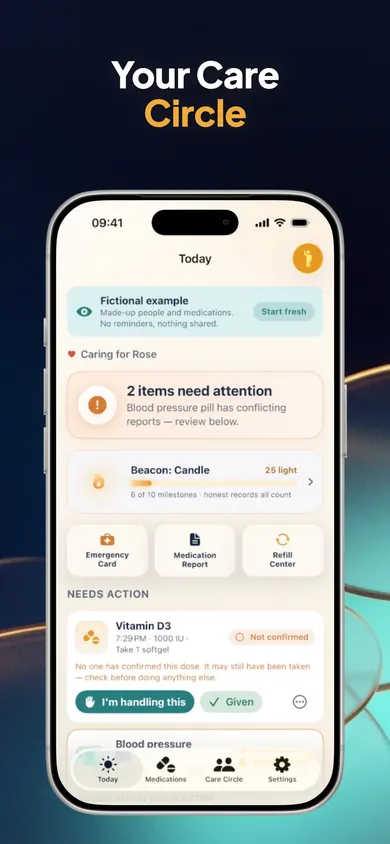
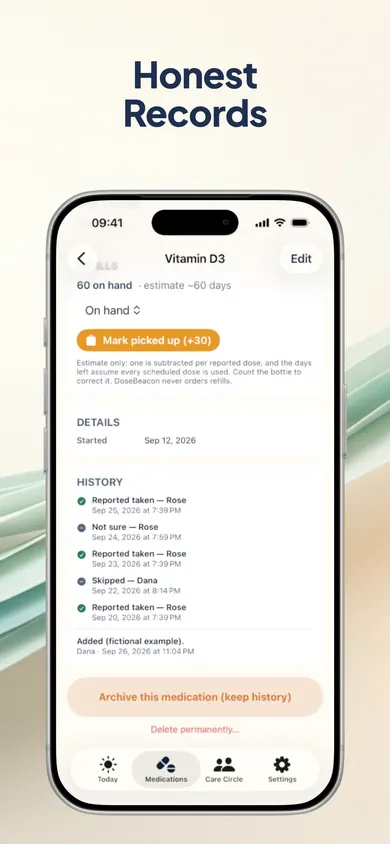
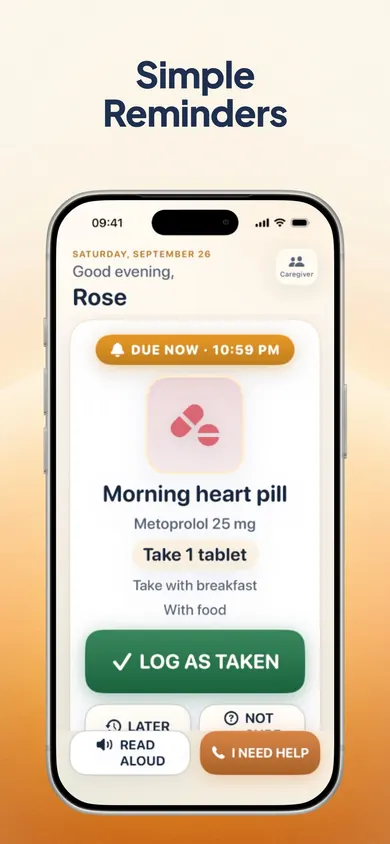
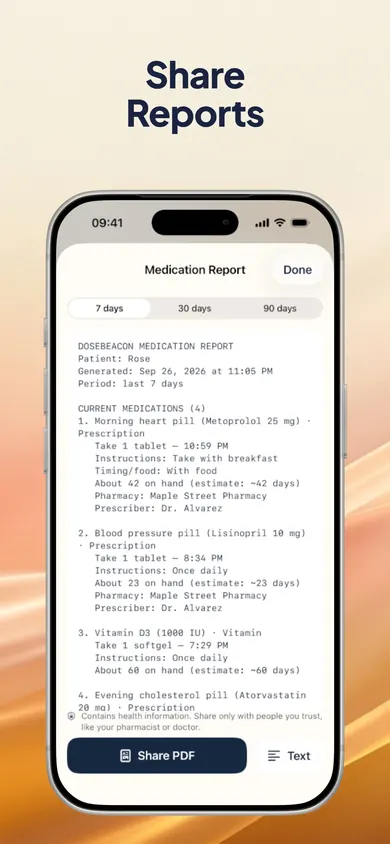
Answer three questions. You get a role for each sibling and a one-line house rule you can paste into the family chat.
Most families start with a group text. It works until the night two people answer "yes" and mean different doses. Here is how the usual options compare for siblings who don't all live with the parent.
| Method | Shows who gave it | Siblings far away can see it | Catches a double report | Cost |
|---|---|---|---|---|
| Group text | If someone replies | Yes | No | Free |
| Shared spreadsheet | If someone types it | Yes | No | Free |
| Paper log on the fridge | If initialed | No | Only by eye | Free |
| Weekly pill organizer | No, only an empty slot | No | No | A few dollars |
| DoseBeacon Care Circle | Yes: person, device, time | Yes, when online | Yes, "Needs review" (Family) | Free for 2; Family $8.99/mo |
The National Institute on Aging (2022) lists charts, calendars, weekly pill boxes, timers and reminder apps as ways to remember medicines, and recommends carrying a list of every prescription, over-the-counter medicine and supplement. A pill organizer and a shared record work well together: the organizer for the hands, the record for the siblings.
If one of you lives with your parent and gives every dose in person, a paper log by the pill box is enough. If your parent has dementia and may take extra pills, a locked automatic dispenser may matter more than any app; we compared both in dispenser vs reminder app. And if half the family is on Android, DoseBeacon won't cover everyone.
DoseBeacon never shows a dose as "missed". If nobody reported it, it says "Not confirmed yet". A sibling who forgot to tap is not the same thing as a parent who skipped a pill, and we didn't want the record to start an argument the facts can't settle.
Keep one list and one record that everyone reads, and agree who is responsible for each dose time. A paper log works if everyone is in the same house. When siblings live apart, a shared app record that shows who reported each dose, and when, removes most of the guessing.
Yes. The free plan includes one helper besides you. DoseBeacon Family ($8.99/month or $59.99/year, with a 7-day free trial for eligible new subscribers) adds more caregivers, unlimited active medications and the Dose Handshake.
Do not give another dose or skip the next one to even things out. Call the pharmacist or prescriber and tell them exactly what happened. With the Dose Handshake (part of DoseBeacon Family), two reports for the same dose are flagged "Needs review" instead of one quietly replacing the other.
Each helper needs DoseBeacon on an iPhone or iPad. There is no Android version, so a sibling on Android can't join the Care Circle; a printed 7, 30 or 90-day report is the fallback for them.
Yes. Senior Mode shows one large card at a time with four choices: Log as taken, Later, Not sure and I need help. It never shows ads or purchase screens.
Yes. You approve every join request, choose the role, and can revoke any device. Corrections add to the history; nothing is silently erased.
Add the evening medicine, invite one sibling, and let the record answer the question instead of the group chat. Reminders, one helper, full history and reports are free.
See DoseBeacon on the App Store · Updated November 2026