How do you help someone with dementia take their medication?
Keep one complete list, use the same calm routine at the same time every day, give one medicine at a time, and write down what actually happened, including "not sure". That is the short version of the National Institute on Aging's caregiver guidance (2021), and it is the job the card above is built for.
Dementia changes the question from "did they remember?" to "does anyone know?". A parent may say yes when the pillbox says no. A sibling may give a dose that was already given at breakfast. So the routine below has two halves: the two minutes in the room, and the record everyone else can read afterwards.
- 0:00 – Same time, same place. A meal or the morning kettle is the anchor. Good light, glasses on, one glass of water.
- 0:20 – One pill, one sentence. "This is your morning pill, with breakfast." Short words, no quiz about what it is for.
- 0:50 – Watch, don't hover. If they refuse, stop. Try again later rather than arguing. Pushing tends to make the next dose harder.
- 1:30 – Record what happened. Taken, later, not sure, or help needed. Not what should have happened.
- 2:00 – If unsure, ask. Never give a second dose "to be safe". Call the pharmacist or prescriber with the medicine name and the time.
The routine is two minutes in the room; the record is what keeps the whole family from doubling up.
What the counter in the card was showing
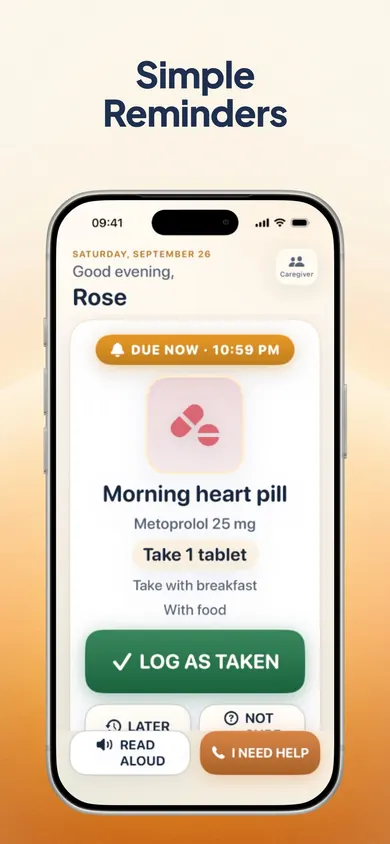
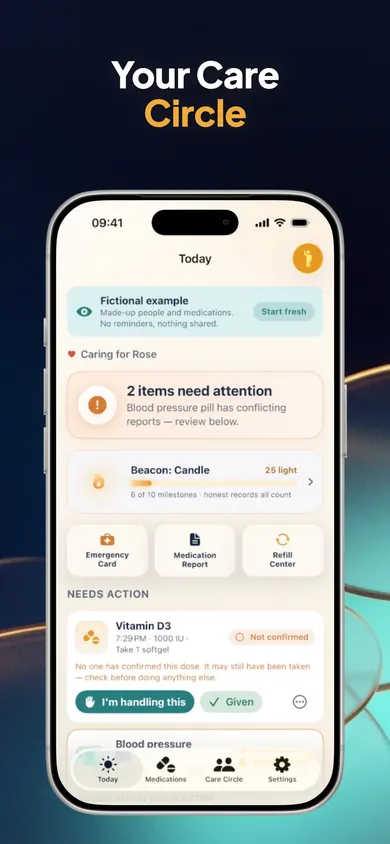
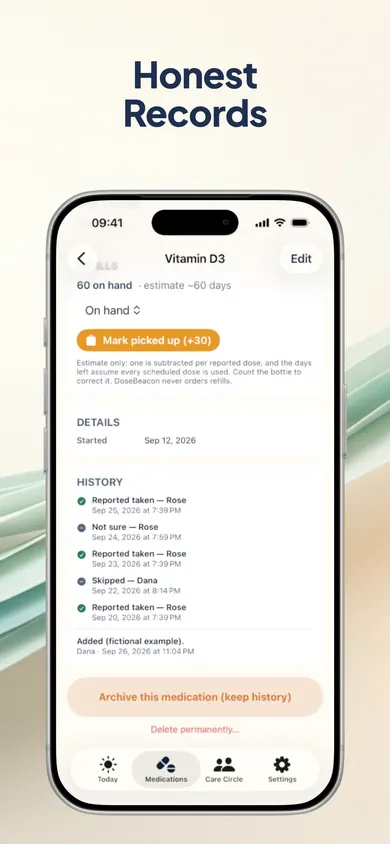
Every tap on the card adds a report to a shared history that approved family members can read, with who reported it, on which device and when. A dose nobody has reported shows as Not confirmed yet, never "missed". A Not sure report is kept as exactly that. We built it this way because, with memory loss in the picture, an honest "not sure" is far safer than a guessed "taken".
Dementia medication questions families ask
How do you get someone with dementia to take their pills?
Keep it calm and simple: one pill, one glass of water, one short sentence, at the same time each day. The National Institute on Aging (2021) suggests reminder calls, notes around the home or a pillbox, and says caregivers usually need to take over as the disease progresses.
What if they say they already took it?
Do not argue, and do not give another dose to be safe. Check the pillbox or the record. If it is still unclear, record it as "not sure" and ask the pharmacist or prescriber what to do with that medicine.
Can I crush pills for someone who has trouble swallowing?
Not without asking first. Some medicines must not be crushed. The National Institute on Aging (2021) advises asking the pharmacist whether a medicine can be crushed or given as a liquid.
Should medicines be locked away?
The National Institute on Aging (2021) lists locking up all medications as one of its tips for families caring for someone with Alzheimer's.
Can several family members share one schedule in DoseBeacon?
Yes, through a Care Circle. Each helper needs DoseBeacon on an iPhone or iPad, and you approve every join request and choose their role. The free plan includes one helper; DoseBeacon Family adds more caregivers.
Is DoseBeacon a medical device?
No. It is a reminder and record-keeping app. It does not give medical advice or recommend doses, and a logged dose is a report, not proof a medicine was taken.
Who this is not for
- Care homes and agencies. If you run medication records for many residents, you need a clinical system. DoseBeacon is a family app for one person's schedule.
- Families who need a second dose physically blocked. A locked automatic dispenser does that; an app only reminds and records.
- Anyone looking for dosing advice. DoseBeacon never recommends doses. That question belongs to the prescriber or pharmacist.
Pillbox, alarm or shared record for dementia care?
The NIA (2021) lists reminder calls, notes and pillboxes, some with alarms. Here is how they differ once memory loss is part of the picture.
| Method | Reminds them | Family can see what happened | Handles "not sure" |
|---|---|---|---|
| Weekly pillbox | No | Only if someone visits | An empty slot helps |
| Pillbox with alarm | Yes | No | Partly |
| Phone alarm | Yes | No | No |
| DoseBeacon | Yes, large card, read-aloud | Yes, with Care Circle | Yes, a recorded choice |
A pillbox shows what is left; a shared record shows who did what, and when.
Honest limits
- A logged dose is a report, not proof. Someone with dementia can tap "Log as taken" and be wrong. The record is only as good as the person tapping.
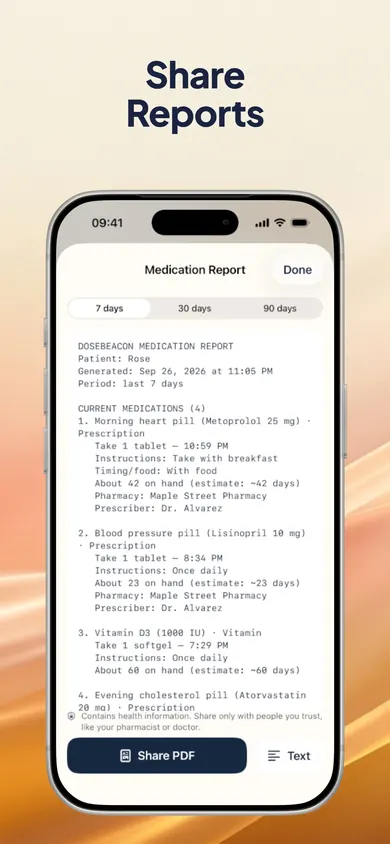
- The free plan covers two active medications, one patient and one helper, with reminders, full history, PDF reports and the emergency card. Many people with dementia take more. DoseBeacon Family adds unlimited active medications, more caregivers and the "I'm handling this" Dose Handshake for $8.99 a month or $59.99 a year.
- Sharing needs a connection. Reminders work offline; the family record updates when phones are online.
- iPhone and iPad only. Every helper in the Care Circle needs one.
Medication harm is common enough to plan for: the CDC (2024) says adverse drug events cause more than one and a half million emergency department visits a year in the United States. The NIA (2021) also asks caregivers to watch for side effects such as confusion and falls, and to report anything unusual after a new medicine starts.
This is general information, not medical advice. Talk to your clinician.
What the screens look like
Set up the morning card before tomorrow
Add the first two medicines, invite one helper, and let the record do the remembering. Open DoseBeacon in the App Store.

Updated November 2026
Related
- DoseBeacon: large-text pill reminders with a family Care CircleLarge-text pill reminders for aging parents, plus a shared record of reported doses for family helpers. Free on iPhone, works offline.
- Can't remember if you took your medication? What to do nowNot sure you took your pill? Why doubling up is the risky move, what NHS pharmacy guidance says, and how to stop the doubt tomorrow.
- Phone alarm vs medication reminder appIs a phone alarm enough for your pills? Five myths checked against studies, an alarm-math tool, and when an alarm really is all you need.
- A shared medication tracker for siblingsSiblings sharing a parent's pills? Scratch a dose card, plan who logs what, and see how a shared record beats the group text. Free on iPhone.