A late-night message
Mum just texted. She can't remember if she took her evening blood pressure pill. Should she take another?
Don't double it on a guess. Check the box first: is tonight's slot empty?
She doesn't use a box. Just the bottle.
Then read the leaflet's "if you forget a dose" section, and if it's still unclear, ring the pharmacy. Most answer that question every day.
And tomorrow?
Tomorrow, set it up so the question can't happen.
An invented example conversation, not a real family.
What should you do if you can't remember taking your medication?
Don't take a second dose on a guess: check for evidence first, read the leaflet, and ask a pharmacist if you're still unsure. General NHS guidance for people who miss a dose says never to double up to make up for a forgotten one unless a prescriber has told you to (Specialist Pharmacy Service, updated March 2025).
The short version, in order:
- Look for evidence. Is today's pill box slot empty? Is there a blister pocket popped? Can you count the bottle against the date it was filled?
- Read the leaflet. Every medicine's patient leaflet has an "if you forget to take" section. That beats any general rule.
- Know the general rule. For most medicines NHS pharmacy guidance says up to 2 hours late is usually fine; later than that depends on how often you take it (SPS, 2025).
- Know the exceptions. Insulin, warfarin, antiseizure medicines, Parkinson's medicines, weekly methotrexate, immunosuppressants and cancer medicines have their own instructions. Ask the team that prescribes them.
- Call a pharmacist when the leaflet doesn't settle it. That is part of their job.
- Write it down. Note the time and "not sure". It helps whoever you ask next.
This is general information, not medical advice. Talk to your clinician or pharmacist about your own medicines.
Why "did I take it?" happens to everyone
Taking a pill is a two-second action you repeat every day. That's exactly the kind of memory that blurs: the brain files today's dose next to yesterday's, and in the evening you can't tell which one you're remembering. It's common, and it is why memory alone is a weak system.
The National Institute on Aging (reviewed 2022) suggests the fixes that turn memory into evidence: weekly pill boxes, charts or calendars you tick, meals or bedtime as anchors, alarms, and smartphone reminder apps. It also says to take medicine in good light, never in the dark.
If forgetting is new, or family members are noticing it more, tell your doctor. That is worth a conversation on its own.
More questions about uncertain doses
I can't remember if I took my pill. Should I take another one?
Not automatically. General NHS pharmacy guidance says never take a double dose to make up for a forgotten one unless a prescriber advises it (Specialist Pharmacy Service, 2025). Check the leaflet, count your pills if you can, and call a pharmacist if you still don't know.
Who can I call about a possibly missed or double dose?
Your pharmacist is the fastest route for most questions, and many pharmacies answer by phone. In the US, Poison Help (1-800-222-1222, free, 24/7) can advise if a double dose may have been taken. In the UK, NHS 111 can advise. If someone is very unwell, call your local emergency number.
How late can I take a missed dose?
It depends on the medicine, so the leaflet comes first. As a general rule, NHS pharmacy guidance says most medicines can be taken up to 2 hours late, with exceptions for medicines like insulin, warfarin and antiseizure drugs (SPS, 2025).
Why do I forget whether I took my medicine?
Because it is a routine action. When you do the same small thing every day, today's memory blurs into yesterday's. That is normal and not, by itself, a sign of a memory problem. Mention it to your doctor if forgetting is new or getting worse.
Does a pill organizer stop the doubt?
Mostly, yes. A filled weekly box shows whether today's slot is empty. The National Institute on Aging (2022) lists weekly pill boxes, charts and calendars as memory aids.
Can DoseBeacon tell if I took my pill?
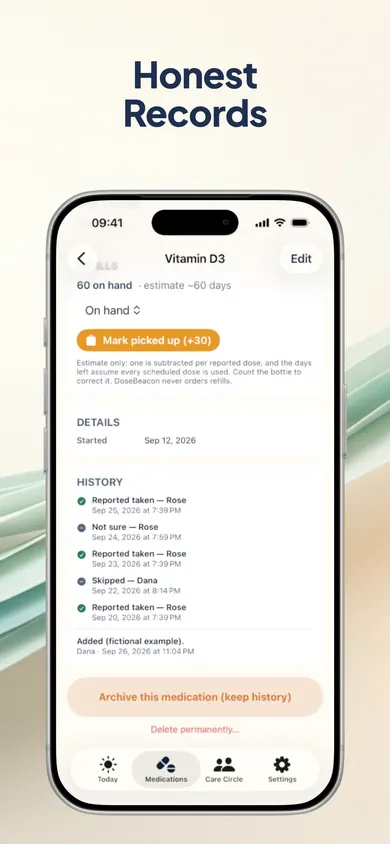
No app can. DoseBeacon records what you report: taken, later, not sure or I need help, with the time and the device. A logged dose is a report, not proof the medicine was swallowed.
What DoseBeacon can and can't do here
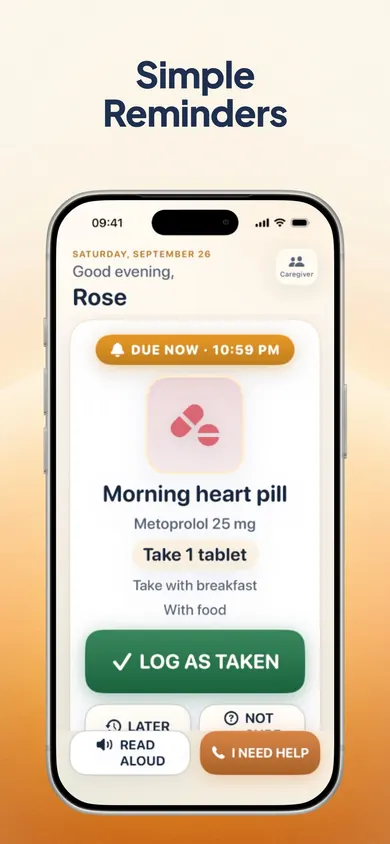
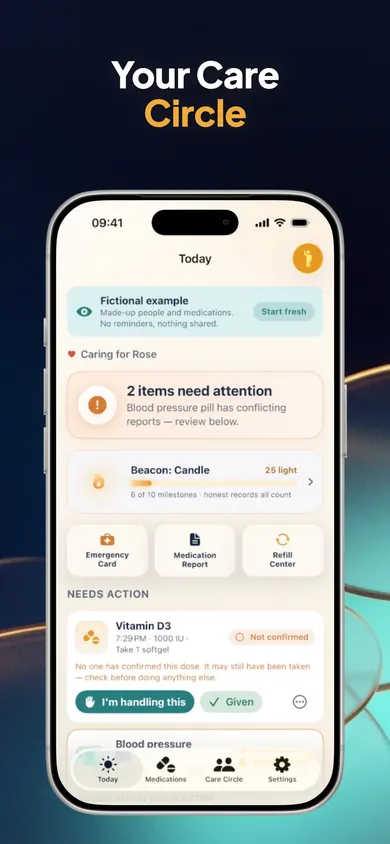
We built DoseBeacon around this exact moment. The reminder card has four answers, not two: Log as taken, Later, Not sure and I need help. We added "Not sure" on purpose, because a record that admits doubt is more useful than one that guesses. A dose nobody reported shows as "Not confirmed yet", never "missed".
- It cannot see whether a pill was swallowed. A logged dose is a report.
- It never tells you whether to take a dose, and it doesn't recommend doses.
- Free covers 1 person, 2 active medications and 1 helper. DoseBeacon Family ($8.99/month or $59.99/year, 7-day trial for eligible new subscribers) adds unlimited medications, more caregivers and the Dose Handshake.
- Sharing with family needs an internet connection; reminders work offline.
Pick something else if the person taking the medicine doesn't use an iPhone or iPad, or if a pharmacy already supplies dated blister packs and a simple alarm is enough.
The screens behind the answer
Get DoseBeacon free
Tomorrow night, answer the reminder card instead of your memory.

DoseBeacon: Pill Reminder on the App Store · Updated November 2026
Related
- DoseBeacon: large-text pill reminders with a family Care CircleLarge-text pill reminders for aging parents, plus a shared record of reported doses for family helpers. Free on iPhone, works offline.
- How to prevent double dosing at home: six mistakes and fixesSix everyday mistakes that lead to a double dose at home, and the fix for each. Pick your household setup and see the one check that matters most.
- How to stop forgetting to take pills: a 10-point checklistA tick-as-you-go checklist for people managing their own medicines, built from National Institute on Aging advice. Free, no sign-up.
- Medication checklist after hospital discharge, with a list-compare toolWhat to do with a parent's pills in the first 48 hours home: a 9-step checklist and a tool that compares the old list with the discharge list.