 Mistake & fix · for families sharing the pills
How do you prevent double dosing medication at home?
Prevent double doses by keeping one shared record that is filled in the moment a dose is given, and checked before anyone gives the next one. Most double doses aren't carelessness. They happen because two people can't see each other, or because "did I take it?" gets answered from memory.
It's a real, measured problem. In U.S. poison center data from 2000 to 2012, the rate of medication errors outside hospitals that caused serious outcomes doubled, and "inadvertently taking the medication twice" was one of the common types named (Hodges et al., Clinical Toxicology (2017)).
A record beats a memory. A shared record beats two good memories.
Six double-dose mistakes, and the fix for each
Two helpers, no handoff
A son gives the 8 AM pill on his way out. His sister drops by at 9, sees the pill box still out, and gives it again. Nobody did anything careless; they just couldn't see each other.
Fix. Pick one place where every dose gets recorded, and read it before giving anything. Agree out loud who owns each time slot.
Trusting memory over evidence
"Did I take it?" is a memory question, and memory is worst at exactly the routine things we do every day.
Fix. Make the answer physical: a weekly pill box filled on the same day each week, or a written chart. The National Institute on Aging (2022) lists pill boxes, charts and calendars for this.
Taking another one to be safe
When unsure, a second pill feels like the cautious choice. For many medicines it's the riskier one.
Fix. Don't double up to make up for a dose unless a prescriber has said to (NHS Specialist Pharmacy Service (2025)). Read the leaflet; ask the pharmacist.
Snoozing and forgetting you snoozed
A reminder goes off mid-conversation. You tap it away, take the pill twenty minutes later, then the next reminder looks like the first.
Fix. Use a reminder that keeps "later" and "taken" as different states, so a snoozed dose still shows as unconfirmed until someone reports it.
A refill that looks different
The pharmacy switches manufacturer, the new tablet is a different color, and the old bottle gets opened too "just in case".
Fix. Learn what each pill looks like by size, shape, color and imprint, and ask the pharmacist when a refill looks unfamiliar (National Institute on Aging (2022)).
Writing it down later
Logging at the end of the day turns a record back into a memory test.
Fix. Record the dose at the moment it's given, with a name and a time. The later the note, the less it's worth.
Every fix on this list is about making the last dose visible to whoever is about to give the next one.
Who this guide is not for
- Someone who may have just taken too much. Stop reading and call Poison Help at 1-800-222-1222 (HRSA) or 911 if they are hard to wake or struggling to breathe.
- Homes that need pills physically locked away, for example with memory loss and a risk of taking extra on purpose or by confusion. A locking dispenser or professional help does a job no app can.
- People who don't use a smartphone at all. A paper chart on the fridge and a weekly pill box will serve better than any app.
An app can show the last dose. It can't hold the bottle.
Honest limits of a double-dose app
We make DoseBeacon, so here is what it does and doesn't do for this problem, straight from its App Store listing.
| What it does | What it can't do |
|---|---|
| Senior Mode shows one large card with four choices: Log as taken, Later, Not sure, I need help. | Know whether a pill was actually swallowed. A logged dose is a report, not proof. |
| History keeps who reported each dose, on which device and when. An unreported dose shows as "Not confirmed yet". | Share anything without a connection. Reminders work offline; the Care Circle needs internet. |
| With the Dose Handshake, a helper taps "I'm handling this", and two reports of the same dose are flagged "Needs review" rather than overwritten. | Give that for free. The Dose Handshake is part of DoseBeacon Family: $8.99 a month or $59.99 a year, with a 7-day free trial for eligible new subscribers. |
Free, with no time limit: reminders, one patient, two active medications, one helper, full history, PDF reports and the emergency card.
One design decision we made on purpose: a claim is never shown as a dose given. "I'm handling this" means someone is on it, not that it's done, because that exact mix-up is how a second dose starts.
The screens that answer "was it given?"
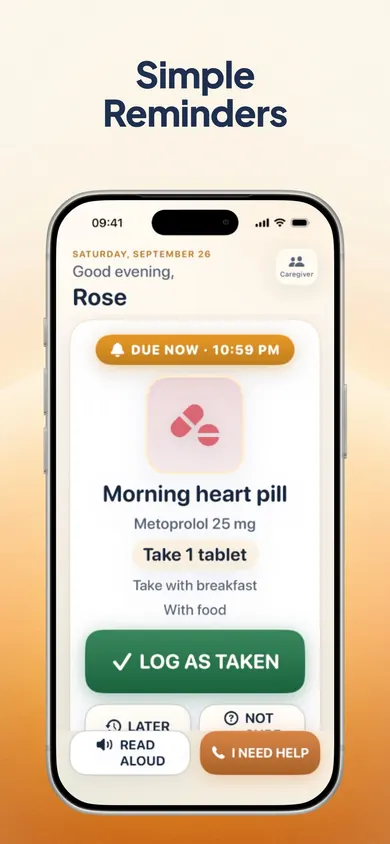
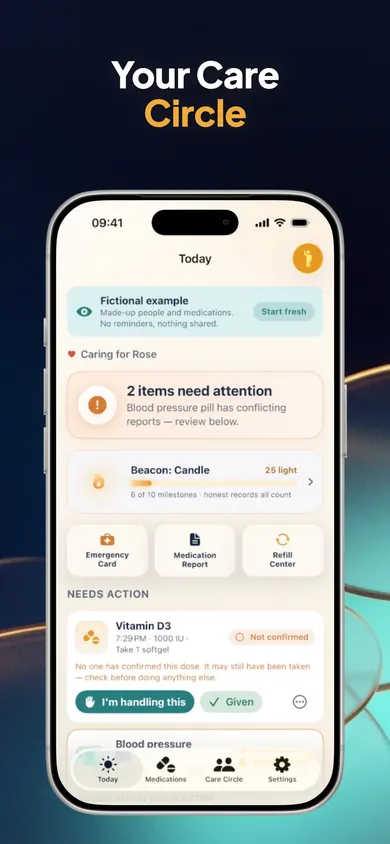
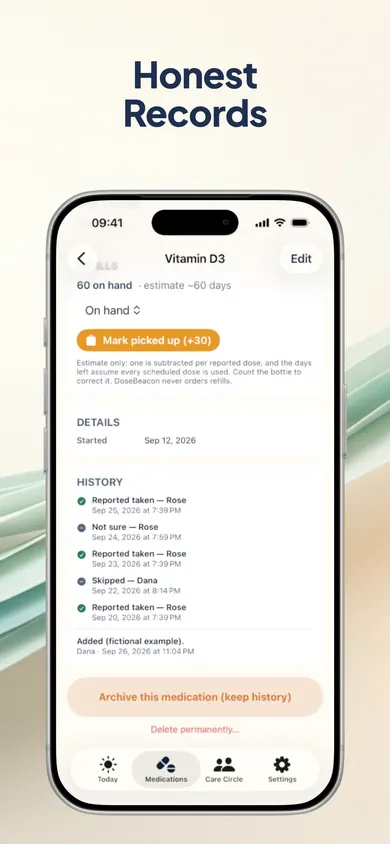
Screens show fictional sample people and medicines.
A Thursday morning, in two versions
Before
7:50, a daughter gives Dad his blood pressure pill and leaves for work. 8:40, her brother stops in, sees the pill box open on the counter and Dad says he isn't sure. He gives one "to be safe". By lunch Dad feels dizzy, and nobody knows which of them to ask.
After
7:50, Dad taps Log as taken on his big card. 8:40, his son opens the app before touching the pill box. It says Reported taken, 7:50, by Dad. He puts the kettle on instead. Ten seconds, one look, no second pill.
The fix wasn't a smarter person. It was a record both of them could see.
Double dosing questions families ask
What should you do if someone took a double dose by accident?
Call Poison Help at 1-800-222-1222 (free, 24/7, connects you to your local poison center, per HRSA) or ask a pharmacist. Call 911 if the person is very drowsy, hard to wake, or has trouble breathing. Have the medicine bottle in your hand when you call.
How common is taking medicine twice by mistake?
Common enough to be named in national poison data. A study of U.S. poison center records from 2000 to 2012 counted 67,603 medication errors outside health care facilities with serious outcomes, and listed inadvertently taking a medication twice among the common types (Hodges et al., Clinical Toxicology (2017)).
Should I take a pill if I'm not sure I already took it?
Not by guessing. NHS pharmacy guidance says never take a double dose to make up for a forgotten one unless a prescriber has told you to (NHS Specialist Pharmacy Service (2025)). Check the leaflet, and ask a pharmacist when the answer isn't clear.
Do pill organizers prevent double dosing?
They help a lot when one person fills them on a fixed day: an empty compartment is a fact, not a memory. The National Institute on Aging (2022) lists weekly pill boxes, charts and calendars as ways to keep track. They help less when two people both refill or both hand out pills.
How do siblings coordinate an elderly parent's medication?
Agree on one record that everyone reads before acting, and one rule for who gives which dose. DoseBeacon's Care Circle shares reported doses with approved family members; its Dose Handshake (tap "I'm handling this") is part of the paid DoseBeacon Family plan.
Can an app stop a double dose?
No app can physically stop a pill. An app can make the last report visible to everyone, with a name and time on it, which removes the guesswork that usually causes the second dose. DoseBeacon calls a logged dose a report, not proof.
This is general information, not medical advice. Talk to your clinician or pharmacist about any specific medicine.
Start on your iPhone
Set up one medicine and one helper for free, and see the last dose before you give the next. Start on your iPhone with DoseBeacon on the App Store.

Updated November 2026
Related
- Can't remember if you took your medication? What to do nowNot sure you took your pill? Why doubling up is the risky move, what NHS pharmacy guidance says, and how to stop the doubt tomorrow.
- DoseBeacon: large-text pill reminders with a family Care CircleLarge-text pill reminders for aging parents, plus a shared record of reported doses for family helpers. Free on iPhone, works offline.
- Medication checklist after hospital discharge, with a list-compare toolWhat to do with a parent's pills in the first 48 hours home: a 9-step checklist and a tool that compares the old list with the discharge list.
- Automatic pill dispenser vs reminder app: a 6-question fit checkAutomatic pill dispenser, reminder app or plain pill box? Answer six questions about your parent and see which method fits, with real costs and limits.