Automatic pill dispenser vs reminder app: which is better?
Choose an automatic dispenser when the risk is taking the wrong pills or too many; choose a reminder app when the risk is forgetting and several family members need to see what happened. A plain weekly pill box beats both when money is tight and one person reliably fills it.
That's the short version. The longer one depends on three things about your parent: whether they use a phone on their own, how much their memory has changed, and how many people are involved. The quiz above asks exactly those.
Buy for the failure you're seeing, not the gadget you saw advertised.
The three methods side by side
| Weekly pill box | Reminder app | Automatic dispenser | |
|---|---|---|---|
| What it does | Holds a week of doses in labelled slots | Alerts on a phone; logs what was reported | Releases pills at set times; alerts with sound and light |
| Stops extra doses? | Partly: an empty slot is visible | No physical stop; shows the last report | Yes, if the model locks pills between doses |
| Family can see it | Only in the room | Yes, when phones are online | Usually, through the maker's app |
| Who fills it | A person, every week | Nobody; pills stay in their bottles | A person, every few weeks to months |
| Typical cost | A few dollars, once | Free tiers exist; paid plans vary | Hero: $29.99–$59.99 a month (see note) |
| Needs | Good eyesight and dexterity | A smartphone they actually use | A wall outlet, Wi-Fi, a monthly plan |
Dispenser figures come from Hero's own product page, checked in November 2026: holds up to a 90-day supply of 10 medicines, pill-time and missed-dose alerts, caregiver monitoring, plans from $29.99 a month prepaid to $59.99 with no commitment. Other brands differ. Pill box and list advice from the National Institute on Aging (2022).
The box is cheapest, the app is most visible, the dispenser is the only one that can say no.
How to choose a medication method in 3 steps
- Name the failure. Is it forgetting (no dose), doubling (two doses), or mixing up bottles (wrong dose)? Write down the last two times something went wrong.
- Match the tool to it. Forgetting points to reminders. Doubling points to a shared record or a locking dispenser. Mix-ups point to a pre-sorted box or a dispenser.
- Run it for two weeks, then check. Look at what actually got missed or doubled. If the answer is "still the same thing", step up a level rather than adding a second gadget.
Three steps, one question underneath: what went wrong last time?
An example: one family, three options
A mother in her late seventies takes five medicines. Her son lives two hours away; her daughter lives ten minutes away and fills a weekly box on Sundays. Twice last month the box showed Tuesday evening still full on Wednesday.
The son priced a dispenser first. Then they looked at the failure: she wasn't taking extra, she was forgetting the evening dose when she fell asleep in front of the TV. A dispenser would have beeped too, but at a monthly fee. They kept the Sunday box, added a phone reminder at 7:30 PM, and both children watch the same record. If memory changes later, the dispenser is still an option.
Start with the cheapest fix that targets the real failure. Step up only when it stops working.
What the reminder-app route looks like with DoseBeacon
We make DoseBeacon, so treat this section as the app side of the comparison, written by the people who built it. Everything here is from its App Store listing.
- For the parent: Senior Mode shows one large card with Log as taken, Later, Not sure and I need help. Reminders are scheduled on the phone and work without internet.
- For the family: a Care Circle you approve, with roles and revocable devices. Every report keeps who made it and when.
- For refills and visits: on-hand counts with labelled estimates, and a 7, 30 or 90-day PDF report.
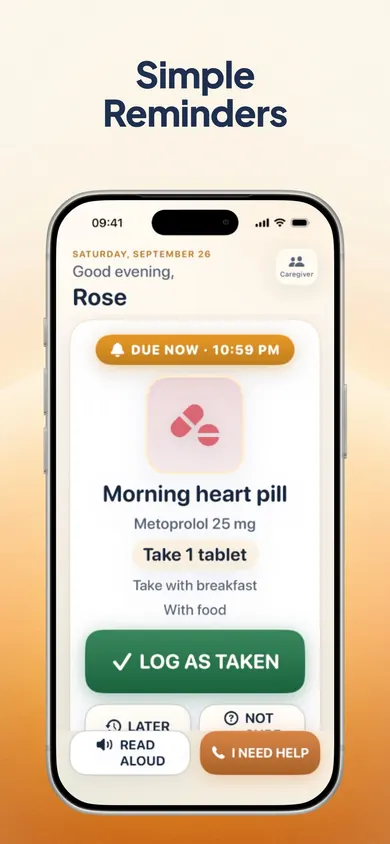
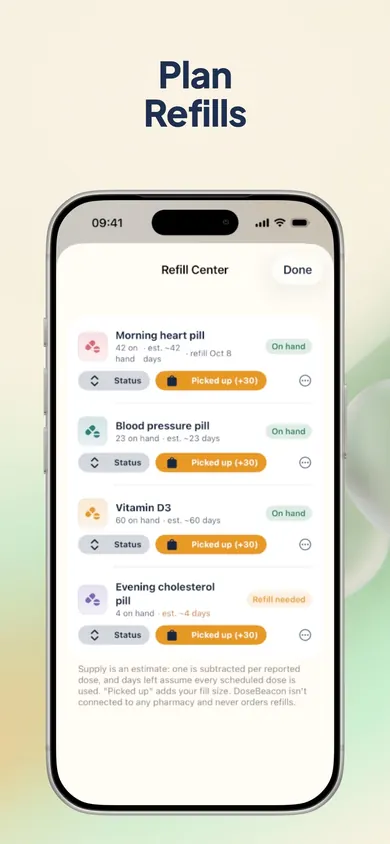
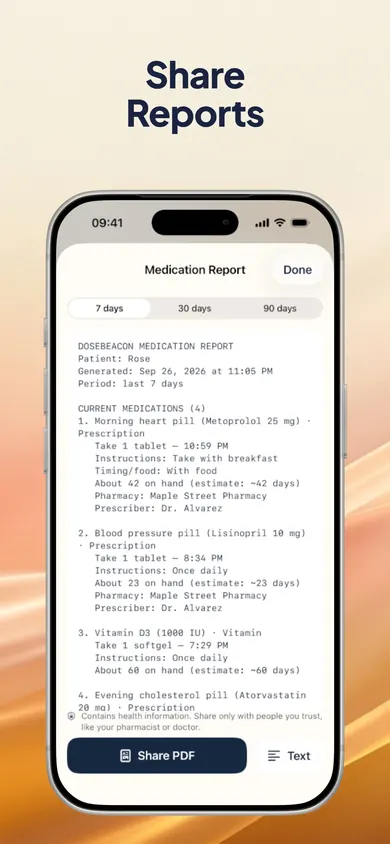
Screens show fictional sample people and medicines.
Honest limits of the app route
- It can't lock anything. If your parent might take extra pills from confusion, an app alone is the wrong tool. A locking dispenser or in-person help is.
- A logged dose is a report, not proof. Someone tapped a button; nobody watched a pill being swallowed.
- Free has limits. Free covers reminders, one patient, two active medications, one helper, full history, reports and the emergency card. DoseBeacon Family ($8.99 a month or $59.99 a year) adds unlimited medications, more caregivers and the Dose Handshake.
- iPhone or iPad only. Each helper needs DoseBeacon on their own Apple device.
A design decision we stand by: Senior Mode never shows ads or purchase screens. The person taking the pills should never meet a paywall at 8 AM.
If the problem is "can't stop taking extra", pick the dispenser, not us.
Dispenser vs app: questions families ask
Is an automatic pill dispenser better than an app?
Neither is better in general. A dispenser releases the right pills at the right time and can hold them back in between, which matters most when confusion is the risk. An app costs less and can share a record with family, but it relies on the person having and using a phone.
How much does an automatic pill dispenser cost per month?
It depends on the brand and plan. Hero, for example, lists plans from $29.99 to $59.99 a month depending on prepayment and a 12-month commitment, with a 30-day money-back guarantee, on Hero's own product page (checked November 2026).
Can a pill reminder app work for someone with dementia?
Sometimes, early on, with a family member watching the shared record. As memory loss progresses, a reminder that asks someone to choose is often not enough, and a locking dispenser or in-person help is the safer route. Ask their doctor.
Does Medicare cover automatic pill dispensers?
Coverage varies by plan and program, and some dispenser makers advertise reduced prices for certain Medicare plans. Ask the plan directly before you buy; we don't give insurance advice.
What is the cheapest way to manage medications for an elderly parent?
A weekly pill box filled on the same day each week, plus a written list of everything they take. The National Institute on Aging (2022) recommends both. Add free phone reminders if they use a smartphone.
Can you use a dispenser and an app together?
Yes. Many families use a dispenser at home and an app for the shared list, refills and doctor reports. Just pick one place as the source of truth for whether a dose was taken.
This is general information, not medical advice. Talk to your clinician or pharmacist about any specific medicine.
Try it tonight
Set one evening reminder and invite one helper, free. If it doesn't solve the real failure, you've lost nothing. Try DoseBeacon tonight on the App Store.

Related
- DoseBeacon: large-text pill reminders with a family Care CircleLarge-text pill reminders for aging parents, plus a shared record of reported doses for family helpers. Free on iPhone, works offline.
- Can't remember if you took your medication? What to do nowNot sure you took your pill? Why doubling up is the risky move, what NHS pharmacy guidance says, and how to stop the doubt tomorrow.
- How to prevent double dosing at home: six mistakes and fixesSix everyday mistakes that lead to a double dose at home, and the fix for each. Pick your household setup and see the one check that matters most.
- How to stop forgetting to take pills: a 10-point checklistA tick-as-you-go checklist for people managing their own medicines, built from National Institute on Aging advice. Free, no sign-up.