Is a phone alarm enough for medication reminders?
A phone alarm is enough for one medicine at one time of day; once you take several medicines at different times, you need a record, not just a sound. An alarm tells you the time. It doesn't name the pill, and when you swipe it away it forgets that it ever rang.
An alarm answers "when?". The question at 10:40 PM is "did I?"
Phone alarm vs. medication reminder app, side by side
| Phone alarm | Weekly pill box | Reminder app (DoseBeacon) | |
|---|---|---|---|
| Names the medicine | Only if you type a label | No | Yes, with dose and instructions |
| Leaves a record | No | An empty slot, until you refill it | Yes: taken, later, not sure, skipped |
| Handles different times | One alarm per time | Usually 1 to 4 slots a day | Each medicine on its own schedule |
| Family can see it | No | Only in the room | Yes, with a Care Circle |
| Refill warning | No | When it looks empty | Estimated, clearly labeled |
| Cost | Free | A few dollars | Free for 2 active medicines |
A pill box and an app are not rivals. The National Institute on Aging (2022) lists meals or bedtime as cues, charts, calendars, weekly pill boxes, timers and smartphone reminder apps as ways to remember medicines. Most people do best with two of these together.
Five myths about medication reminders
Myth If you're organized, doses don't slip.
Fact A 2011 review in Mayo Clinic Proceedings estimated that about 50% of patients on long-term medicines don't take them as prescribed, and named complex drug regimens as one of the causes. Slipping is common, not a character flaw.
Myth Reminders don't really change anything.
Fact In a 2016 JAMA Internal Medicine meta-analysis of 16 trials, text-message reminders roughly doubled the odds of good adherence (odds ratio 2.11). Most trials used self-report and ran about 12 weeks, so treat it as encouraging, not as a promise.
Myth An alarm with a label is the same as an app.
Fact A labeled alarm names the pill, which helps. It still can't record what you did, warn you about a refill or show a family member that the dose happened.
Myth An app knows whether I took my pill.
Fact No app can see you swallow. A logged dose in DoseBeacon is a report you made, and the app says so. That's still far more than an alarm keeps.
Myth The app will tell me what to do about a missed dose.
Fact It shouldn't, and DoseBeacon doesn't. Missed-dose rules differ by medicine. Your pharmacist or the leaflet that came with the medicine is the place to ask.
Alarm math: what would your alarms have to remember?
Set your own numbers. We count one alarm per dose time, which is how most people set them up.
Switching from alarms in 3 steps
- Scan the pharmacy labels. On-device text recognition makes a draft. Check every field yourself before any reminder turns on.
- Answer the card. When a dose is due, one card asks: Log as taken, Later, Not sure or I need help. "Not sure" is a real answer, not a failure.
- Read the history, not your memory. At 10:40 PM, the record shows what you reported and when. If it says "Not confirmed yet", ask a pharmacist before taking anything extra.
Honest limits
- Two active medicines are free. If you take four or five, you'll need DoseBeacon Family ($8.99/month or $59.99/year; 7-day free trial for eligible new subscribers) or you'll be juggling archived and active medicines.
- Notifications depend on your iPhone settings. Focus modes and muted notifications can quiet a reminder, the same as any app.
- iPhone and iPad only. No Android, no watch-only version.
- Not a medical device. No dose advice, no interaction checks. Your pharmacist does that.
Who should keep the alarm: if you take one medicine once a day and have never wondered whether you took it, a labeled phone alarm is the simplest tool there is. Keep it.
This is general information, not medical advice. Talk to your clinician.
What replaces the alarm
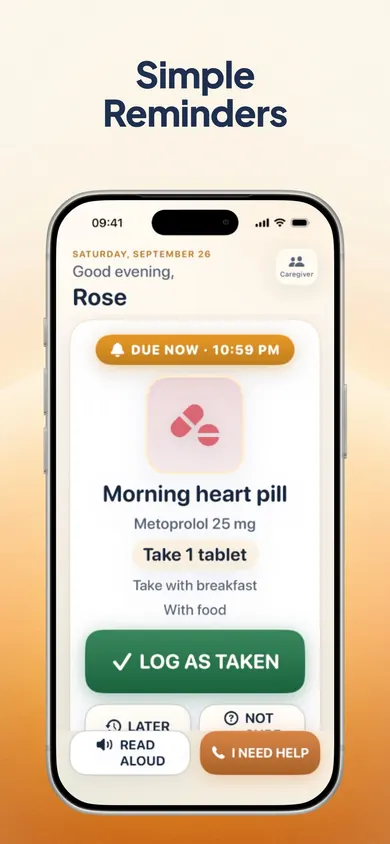
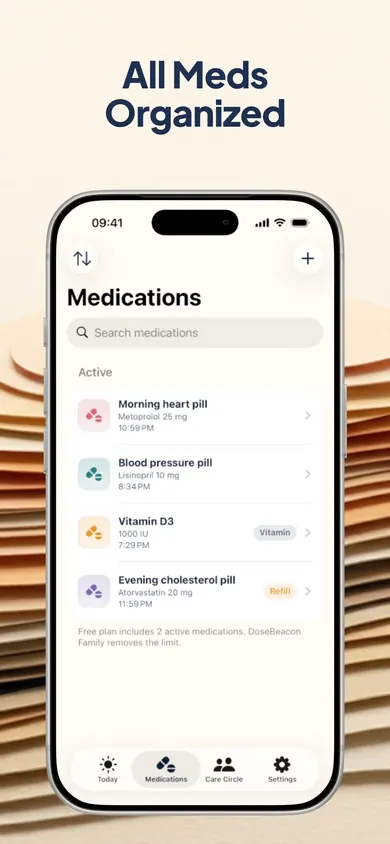
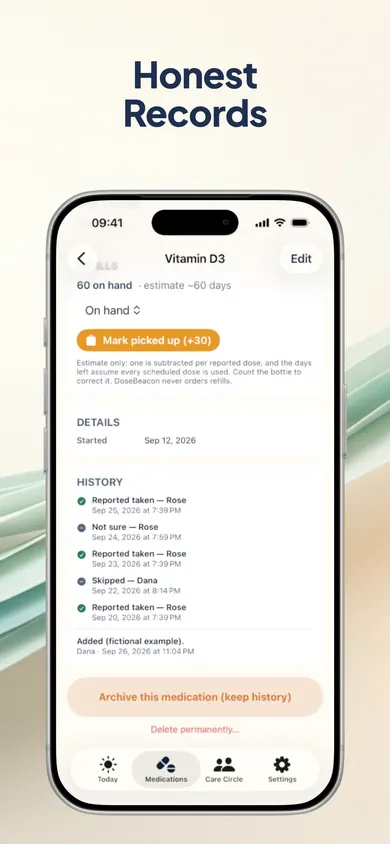
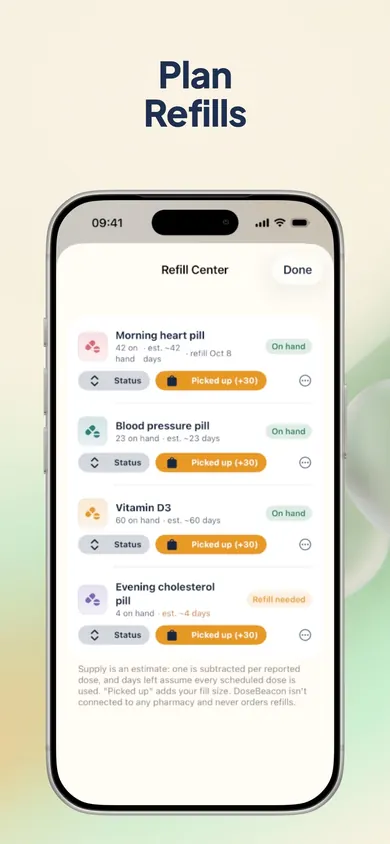
A design decision we made: DoseBeacon has no streaks. A streak quietly rewards tapping "taken" when you aren't sure, and that is the one lie a medication record can't afford.
Questions about alarms and reminder apps
Is a phone alarm good enough for taking medication?
For one medicine once a day, often yes. Once you take several medicines at different times, an alarm only tells you the time. It can't tell you which pill it was for, and once it's dismissed there is no record of whether you took it.
Do medication reminder apps actually help?
Reminders in general seem to. A 2016 meta-analysis in JAMA Internal Medicine of 16 randomized trials (2,742 patients) found text-message reminders roughly doubled the odds of taking medicines as prescribed, though most trials relied on self-report and ran about 12 weeks.
Doesn't the iPhone Health app already do medication reminders?
Yes. Apple's Health app has a Medications section that reminds you and lets you log doses, and it's free and built in. Pick DoseBeacon instead if you want Senior Mode's one-card-at-a-time screen, a Care Circle so family can see reported doses, refill estimates or a printable emergency card.
How many medicines can I track free in DoseBeacon?
Two active medications on the free plan, with reminders, full history, reports and the emergency card. Unlimited active medications, more caregivers and the Dose Handshake are part of DoseBeacon Family at $8.99/month or $59.99/year.
What should I do if I'm not sure I took a dose?
Don't guess and don't double up. Ask your pharmacist or prescriber, or check the instructions that came with that medicine. DoseBeacon lets you record "Not sure" honestly, but it never tells you whether to take a dose.
Will an app work without internet?
DoseBeacon's reminders are scheduled on the iPhone itself, so they work offline. Only sharing with family needs a connection.
Start on your iPhone tonight
Add your evening medicines, answer the first card, and look at the history before bed. Keep your alarm too, if you like it.

DoseBeacon on the App Store · Updated November 2026
Related
- DoseBeacon: large-text pill reminders with a family Care CircleLarge-text pill reminders for aging parents, plus a shared record of reported doses for family helpers. Free on iPhone, works offline.
- Can't remember if you took your medication? What to do nowNot sure you took your pill? Why doubling up is the risky move, what NHS pharmacy guidance says, and how to stop the doubt tomorrow.
- How to help someone with dementia take medicationA calm 2-minute pill check for families caring for someone with dementia: what to do, what to record, and when to call the pharmacist.
- How to stop forgetting to take pills: a 10-point checklistA tick-as-you-go checklist for people managing their own medicines, built from National Institute on Aging advice. Free, no sign-up.