Which cold remedies actually work?
Honey for coughs (over age 1), fluids, rest and saline ease symptoms; zinc may shorten a cold slightly; vitamin C started after you're sick doesn't clearly help; antibiotics don't work on colds. Nothing cures a cold, and most people feel better in about 1 to 2 weeks (NHS, 2024). The grades above come from Mayo Clinic (2024), two Cochrane reviews and the NHS, each linked.
This is general information, not medical advice. Talk to your clinician, especially for children, pregnancy or long-term conditions.
A cold-season conversation
I've got a cold. I've already had three vitamin C tablets today. That helps, right?
Started after the cold began? Trials found no consistent effect. The small benefit was in people taking it every day before they got sick: about 8% shorter colds in adults.
8%? That's like half a day.
Roughly, on a week-long cold. Honey for the cough and saline for the stuffy nose have better support for how you feel today.
And the leftover antibiotics in the drawer?
Leave them. Colds are viral. Antibiotics don't touch them.
Who this guide is not for
If you have trouble breathing, chest pain, a high temperature for more than 3 days, or symptoms that keep getting worse, skip the remedies and get medical advice (NHS). The same goes for babies and for anyone with a weakened immune system. Body Unpacked is an education app: it doesn't diagnose and gives no individual supplement or medication advice.
How the evidence grades are built
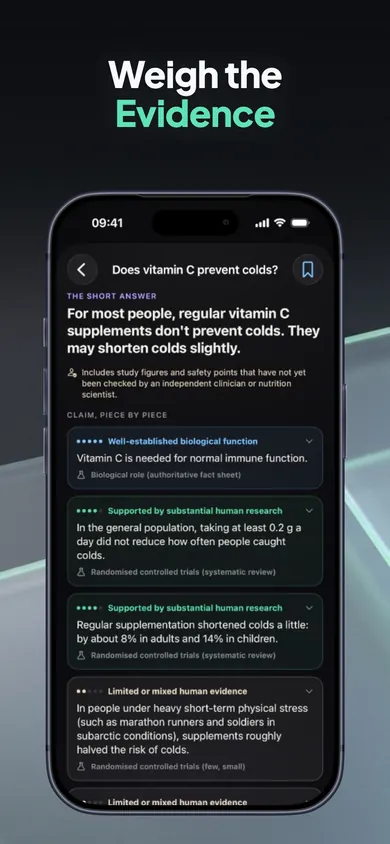
Each card on this page follows the same three-question check we use in Body Unpacked's Evidence Lens:
- 1What exactly is the claim? "Vitamin C helps colds" is really two claims: preventing them and shortening them. They have different answers.
- 2What kind of evidence is behind it? A systematic review of many trials outweighs one study. Cochrane reviews pool randomized trials, then rate how certain the result is.
- 3How big is the effect, for whom? In marathon runners, skiers and soldiers on subarctic exercises, vitamin C roughly halved colds (Cochrane, 2013). For everyone else, it didn't prevent them.
Cold remedy questions people ask
Does vitamin C help a cold once it has started?
Probably not. In the Cochrane review (Hemilä & Chalker, 2013), trials that started vitamin C after symptoms began found no consistent effect on how long colds lasted or how bad they were. Taking it regularly beforehand shortened colds by about 8% in adults.
Is zinc worth taking for a cold?
Maybe, with caveats. The 2024 Cochrane review found zinc taken for treatment may shorten colds by about 2.4 days (low-certainty evidence) and probably increases side effects like nausea and bad taste. Mayo Clinic (2024) notes the FDA warns against nasal zinc, which can cause loss of smell.
Do antibiotics help a cold?
No. Colds are caused by viruses. The NHS (reviewed 2024) says GPs don't recommend antibiotics for colds because they won't relieve symptoms or speed up recovery.
How long does a cold usually last?
Most people start to feel better in about 1 to 2 weeks, according to the NHS (2024).
When should I see a doctor about a cold?
The NHS suggests getting advice if a high temperature lasts more than 3 days, symptoms get worse or haven't improved after 10 days, you feel breathless or have chest pain, a cough lasts over 3 weeks, or you have a long-term condition or weakened immune system.
Can I give cold medicine to my young child?
Mayo Clinic (2024) says not to give any cough and cold medicines to children under 4, and to talk to a healthcare professional first for ages 4 to 6. Honey is only for children over 1.
Seven remedies at a glance
| Remedy | Verdict | Source |
|---|---|---|
| Honey (cough, age 1+) | Helps | Mayo Clinic 2024 |
| Fluids and rest | Helps | Mayo 2024, NHS 2024 |
| Saline spray, salt gargle | Eases symptoms | Mayo Clinic 2024 |
| Zinc, started early | Maybe, ~2.4 days | Cochrane 2024 |
| Daily vitamin C beforehand | Small, 8% adults | Cochrane 2013 |
| Vitamin C once sick | No clear effect | Cochrane 2013 |
| Antibiotics | Doesn't work | NHS 2024 |
One honest limit: this table covers what we could source from Cochrane, Mayo Clinic and the NHS. We left out remedies those sources don't rate, rather than guess.
Use the app for the next health claim, in 3 steps
- Open Evidence Lens. Six popular questions, including vitamin C and "8 glasses of water", split into 23 statements.
- Read the label. Each statement is tagged by evidence type, from established physiological role to insufficient evidence, with its named source.
- Follow the nutrient. Tap into the Atlas or a Nutrient Journey to see where vitamin C or zinc actually works in the body.
A design choice we made: no "healthier" scores anywhere, just what a food contains and what the evidence says. Body Unpacked is free to download, with no account, no ads and no analytics, and all content works offline. It is an education app, not a symptom checker.
Start on your iPhone
249 sourced topics, 14 nutrient journeys and the Evidence Lens, in your pocket for the next "does this work?"

Body Unpacked: Health Atlas on the App Store · Updated November 2026
Related
- Body Unpacked: a human body and nutrition atlasFollow a food into your body: pick spinach, tap iron, see its job and where it happens. A sourced human body and nutrition app for iPhone.
- Vitamins and what they do: all 13 in five minutesAll 13 vitamins and what each one does, in plain English, sourced to NIH. Pick your situation to see which ones matter most for you.
- A human body app for homeschool, with a ready 15-minute lessonFor homeschool parents teaching the human body to tweens and teens: a 15-minute lesson you can run tonight, and three apps compared from their listings.
- Best human body app for beginners: four App Store listings comparedWhat's the best human body app for beginners? Four iPhone apps compared from their App Store listings: what's free, what it costs, and who each one suits.