Honest comparison · beginners · Updated November 2026
What's the best human body app for beginners?
For curious adults and teens starting from zero: four iPhone apps, checked against their listings.
Since you opened this page, a resting adult heart has beaten
0to0times
Normal adult resting range: 60 to 100 beats a minute (MedlinePlus).
Free on iPhone
What is the best human body app for beginners?
For a true beginner, the best human body app explains what the body does before asking you to name its parts; if naming parts on a 3D model is your goal, start with an atlas that gives a couple of systems free. The counter above is the kind of thing that hooks beginners: a number about your own body, with a source.
We make Body Unpacked, one of the four apps below. The other three are described from their own US App Store listings, read in November 2026, as fairly as we can. Prices change; the listing is always the final word.
Start with how it works. The names come easier after.
Four human body apps compared for beginners
Best for: Understanding how the body works, starting from food
Body Unpacked: Health Atlas
We make this
Price
Free; no in-app purchases listed
What's inside
Food-to-body explorer for 44 foods, 14 nutrient journeys, step-through digestion, breathing and reflex models, 249 sourced topics in Simple, Standard or Deep dive
Free download; weekly and yearly subscriptions, in-app purchases $2.99 to $49.99
What's inside
3D models of every major system, layers, isolate or hide structures, muscle details, pins, AR and quiz modes
Offline
Not stated
Privacy label
Identifiers and usage data used to track you
For beginners
Steeper: aimed at study-level detail
Best for: A 3D reference library with Latin terms
Human Body Atlas: 3D Medical
Price
Free download; subscriptions from $6.99/week, plus one-off purchases up to $25.99
What's inside
Layered 3D organs and systems, AR mode, 500+ reference articles with Latin names, voice search
Offline
Yes, per listing
Privacy label
IDs, usage, coarse location and advertising data, not linked to you
For beginners
Medium: rich, but medical vocabulary
Sources: each app's US App Store listing, November 2026. Privacy labels are self-reported by developers and not verified by Apple. No competitor logos are used; names link to the developers' own websites where one is listed.
Three of the four are 3D atlases. Only one starts from what you ate for lunch.
What Body Unpacked looks like for a beginner
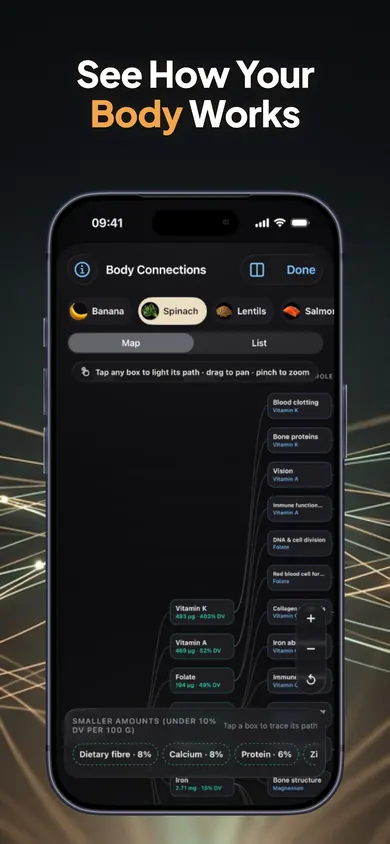
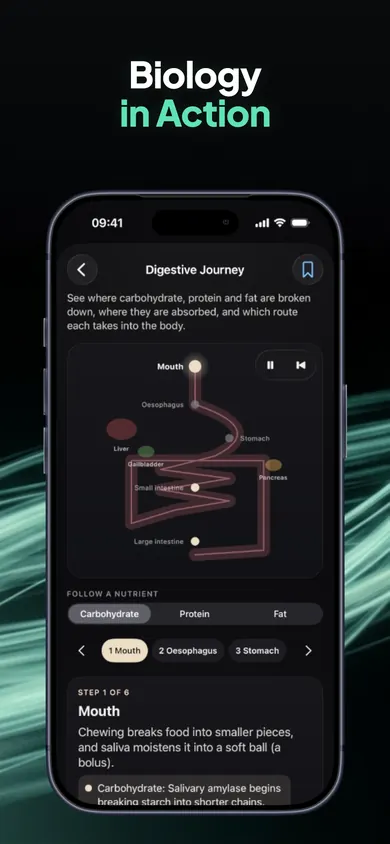
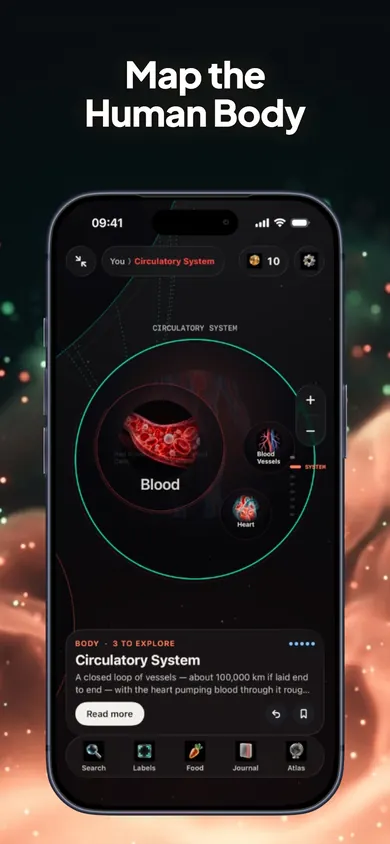
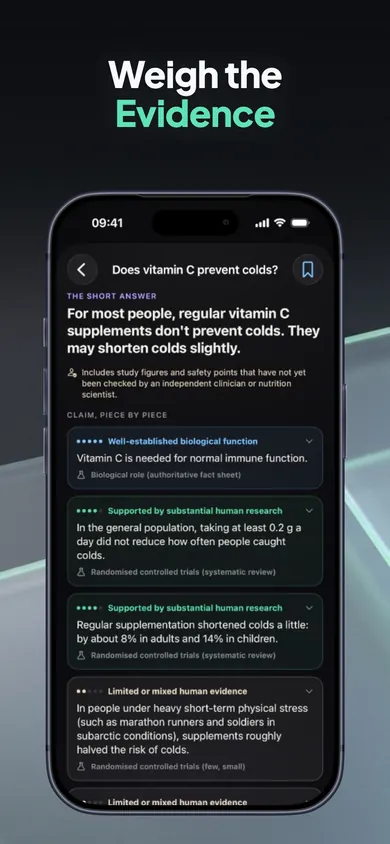
Pick a food; the graph draws its nutrients and their jobs.Digestion, one labelled step at a time.Body map: one system, plain-English facts.Evidence Lens: each claim labelled by its evidence.
How to learn the human body as a beginner, in 3 steps
Follow one thing all the way through. A bite of food, a breath, a reflex. In Body Unpacked that's a nutrient journey or a lab model.
Then place the parts. Once you know what the stomach does, finding it on a map sticks. Assemble the Body has you drag organs to where they really sit.
Check yourself, lightly. Short checkpoints at the end of each journey, not a timed exam.
Story first, map second, quiz third. That's the beginner order.
Human body app questions beginners ask
What is the best app to learn the human body for free?
For a free start with no paid tier, Body Unpacked lists no in-app purchases. If you specifically want to spin 3D bones and muscles, Human Anatomy (Asaru Labs) gives the skeletal and muscular systems free and charges for the other 12 systems.
Should a beginner start with a 3D anatomy app?
Only if you already know you like learning by rotating models. 3D atlases name thousands of parts, which can overwhelm a beginner. Many people find it easier to start with what the body does, then learn where each part sits.
Are anatomy apps accurate?
Check the listing for where the content comes from. Human Anatomy says its models are based on the BodyParts3D dataset; Body Unpacked names a source for every claim. None of these apps replace a textbook or a teacher for exams.
Can I learn anatomy on my phone without internet?
Some apps say so. Human Body Atlas and Body Unpacked both state they work offline in their listings. The other two listings we read don't say either way.
Do anatomy apps collect data?
Read the App Privacy section. In November 2026, the labels ranged from tracking location and identifiers for advertising to collecting no data at all. Labels are self-reported by developers and not verified by Apple.
What's the difference between an anatomy app and a physiology app?
Anatomy is where things are; physiology is how they work. Most 3D apps are anatomy-first. Body Unpacked is physiology-first: it follows food, nutrients, blood and nerves through the body.
What the counter at the top was showing
The counter multiplies the seconds you've spent on this page by the normal resting range for adults: 60 to 100 heartbeats a minute, or 12 to 18 breaths a minute (MedlinePlus, NIH (reviewed 2025)). It isn't your heart rate. It's the range a healthy resting adult falls into, which is why it shows two numbers, not one.
Time on page
Heartbeats
Breaths
1 minute
60 to 100
12 to 18
5 minutes
300 to 500
60 to 90
1 hour
3,600 to 6,000
720 to 1,080
A range with a source beats a single number without one. That's the whole philosophy of the app.
A beginner's first evening
A 40-year-old who skipped biology downloads a 3D atlas, spins a skull, sees 925 labels and closes it. Next evening she tries a different route: picks spinach, taps iron, and reads that iron helps red blood cells carry oxygen, and that the body has no exit for spare iron, so the gut decides how much comes in. Twenty minutes later she's on the breathing model, then the heart. She still can't name the bones of the wrist. She doesn't need to yet.
Curiosity first. The 925 labels can wait.
Honest limits of Body Unpacked
It's not a 3D anatomy atlas. There's no rotating skeleton and no muscle origins. If that's what you need, pick one of the other three.
Content is checked by us against the cited public sources and hasn't been independently reviewed by a clinician.
Education only. It doesn't diagnose and gives no individual supplement or medication advice.
English only, iPhone, rated 13+. Illustrations are simplified artwork made with AI-assisted tools.
One design decision we made: missing nutrient data is shown as missing, never as zero. A zero you can't trust teaches the wrong thing, and beginners can't tell the difference.
This is general information, not medical advice. Talk to your clinician.