Liver vs gallbladder
The liver makes bile. The gallbladder stores it and releases it when you eat.
Glossary · before the test
For biology, nursing-prep and anatomy students: 18 terms in the order a bite of food meets them. Tick the ones you could explain.
Start with the first stop below. Your ticks stay on this page only.
 Free on iPhone · works offline
Learn the terms in the order food travels: mouth, esophagus, stomach, small intestine, large intestine, rectum, with the liver, pancreas and gallbladder feeding juices in along the way. Every definition below is a plain-English summary of the {aN}.
A list is easier to remember when it is a route.
You chew. Salivary glands add saliva, and its enzymes start on the starch in the bread. You swallow, and peristalsis carries the bite down the esophagus. The lower esophageal sphincter opens, lets it into the stomach, and closes again. Stomach acid and enzymes go to work while the stomach muscles mix. Slowly, the stomach empties into the duodenum.
Now the helpers join. The pancreas sends enzymes for the carbohydrate, fat and protein. The gallbladder squeezes out bile that the liver made, for the butter. Through the jejunum and ileum, the small intestine walls absorb the nutrients into the blood. What's left moves into the large intestine, which pulls out water and forms stool, stored in the rectum until later.
Eighteen words, one journey.
The liver makes bile. The gallbladder stores it and releases it when you eat.
Small: finishes digestion and absorbs nutrients. Large: absorbs water and forms stool.
Both make enzymes. The stomach works on food inside itself; the pancreas sends its juice to the small intestine.
Food passes through hollow organs (the GI tract). It never passes through the liver, pancreas or gallbladder.
Most wrong answers on a quiz are one of these four swaps.
Updated November 2026. Definitions summarize the {aN}.
Mouth to anus
The gastrointestinal tract: the long tube of hollow organs food passes through, from the mouth to the anus.
Mouth
Glands that make saliva, a digestive juice that moistens food so it moves more easily.
Mouth
The first digestive juice. It moistens food and starts breaking down starches.
Whole tract
The wave-like muscle movement that pushes food along the GI tract.
Throat to stomach
The muscular tube that carries swallowed food to the stomach, driven by peristalsis.
Top of stomach
A ring of muscle that opens to let food into the stomach and usually stays closed so stomach contents don't flow back up.
Upper abdomen
Stomach glands make acid and enzymes; stomach muscles mix food with these juices, then empty it slowly into the small intestine.
Several organs
A protein in digestive juices that breaks food down into smaller parts the body can use.
Middle of abdomen
Finishes digestion with juices from the pancreas, liver and intestine, and absorbs water and nutrients into the bloodstream.
Small intestine, part 1
The first section of the small intestine, where food arrives from the stomach.
Small intestine, part 2
The middle section of the small intestine.
Small intestine, part 3
The last section of the small intestine, before the large intestine.
Behind the stomach
A solid accessory organ that makes a juice with enzymes for carbohydrates, fats and proteins, delivered to the small intestine.
Upper right abdomen
An accessory organ that makes bile, and stores, processes and delivers nutrients.
Liver to small intestine
A digestive juice made by the liver that helps digest fats and some vitamins.
Under the liver
Stores bile between meals and releases it into the small intestine when you eat.
Around the abdomen
Absorbs water and turns waste from liquid into stool. Its parts include the cecum, appendix, colon and rectum.
End of large intestine
The lower end of the large intestine. It stores stool until a bowel movement pushes it out through the anus.
Words on a page only go so far. Body Unpacked's Physiology Lab has a step-through model of digestion from mouth to colon: pause, restart, follow the labels, then answer short checkpoints. You can also follow 14 nutrients on an animated body map, for example vitamin B12, which the app shows being absorbed at the very end of the small intestine.
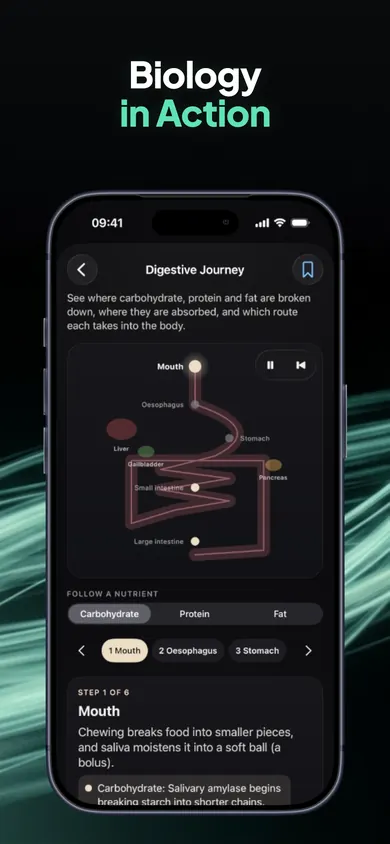
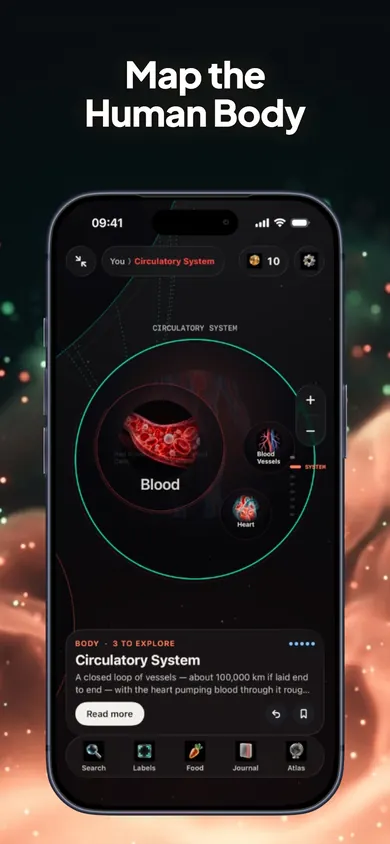
One design decision we made: every topic switches between Simple, Standard and Deep dive, so the same page works for a 12-year-old and a nursing student. One limitation: the content is checked by us against the cited public sources, not independently reviewed by a clinician. Who should pick something else: if you need 3D dissection-level anatomy for a university course, a dedicated anatomy atlas will go deeper than we do.
The hollow organs of the GI tract (mouth, esophagus, stomach, small intestine, large intestine and anus) plus the solid accessory organs: liver, pancreas and gallbladder. Source: NIDDK, National Institutes of Health (reviewed 2017).
The liver makes bile; the gallbladder stores it between meals and releases it into the small intestine when you eat (NIDDK, National Institutes of Health (reviewed 2017)).
In the small intestine, whose walls absorb water and digested nutrients into the bloodstream (NIDDK, National Institutes of Health (reviewed 2017)).
The wave-like muscle movement that pushes food through the GI tract, starting in the esophagus after you swallow.
Duodenum, jejunum and ileum, in that order.
No. It is an education app. It does not diagnose, treat or replace advice from a qualified professional, and its content has not been independently reviewed by a clinician.
This is general information, not medical advice. Talk to your clinician.
No account, no ads, works offline. Start on your iPhone: Body Unpacked on the App Store.