How do you teach kids to read food labels?
Teach one part of the label at a time, in this order: serving size, then the ingredients list, then comparing one number across two real packages, and save % Daily Value for kids who already know percentages. Every food label lesson that sticks uses real boxes from your own cupboard, not a worksheet.
The order matters because each step leans on the one before. MedlinePlus, NIH (2024) says to check serving size first, since every number below it is for one serving. The NHS (reviewed 2026) adds that ingredients are listed by weight, largest first, which is the easiest "aha" for a young child.
One skill per snack. Four snacks, and they can read a label.
The food label decision flowchart
- Can they multiply by 2?No: start with the ingredients list. Count where sugar appears. First three means a lot.Yes: go on.
- Can they find "Serving size"?No: practise on three boxes. Ask "how many servings in this whole box?"Yes: go on.
- Do they know what a percent is?No: compare grams. Put two cereals side by side and ask which has more fibre per serving.Yes: go on.
- Teach % Daily Value with two numbers: 5 and 20.5% or less is low (FDA, which designs the U.S. label (2024)); 20% or more is a high source (NIH Office of Dietary Supplements).
If they're stuck on a step, the step before it isn't solid yet.
Who this guide is not for
- Families managing a food allergy. Label reading for allergens has its own rules and stakes. Follow your allergist's plan.
- Kids with a medical diet, such as diabetes carb counting. Their care team should set what to look for.
- Anyone worried about a child's eating or weight. Talk to their doctor first. This page teaches reading, not dieting.
This is a reading lesson. It isn't a diet plan, and it shouldn't feel like one.
A Saturday at the kitchen table
A twelve-year-old and her dad empty the snack shelf: two cereals, granola bars, crackers. Round one, she finds the serving size on each and gets a shock: the crackers box is "about 9 servings". Round two, she reads the ingredients and spots sugar listed second on one cereal. Round three, the two cereals side by side, fibre per serving. Twenty minutes, no lecture, and she's the one explaining it at dinner.
Then she asked what fibre actually does. That's where the app came in.
The best label lesson ends with a question you didn't plan.
Annotated tour: the screens a teen uses after the label
Body Unpacked picks up where a label stops: what a nutrient does and where in the body it does it. We make Body Unpacked; here is what's on screen, labelled.
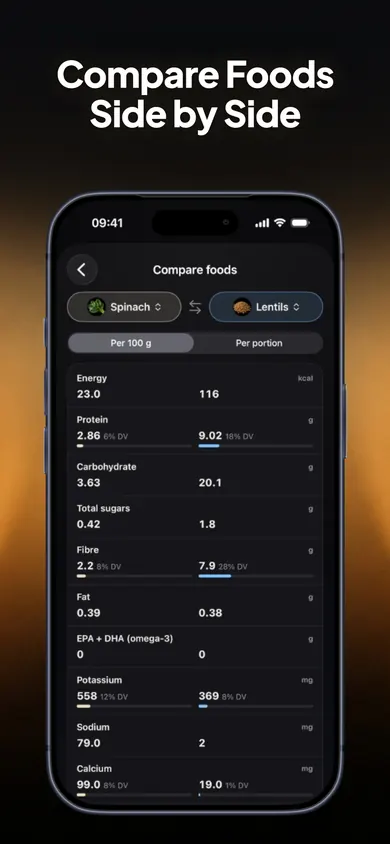
- Two foods, side by side. 14 nutrients, per 100 g or per a checked household portion.
- %DV shown with its basis. Each %DV names its amount basis and the FDA reference it uses.
- No "healthier" score. Just what each food contains. The same rule as the kitchen-table lesson.
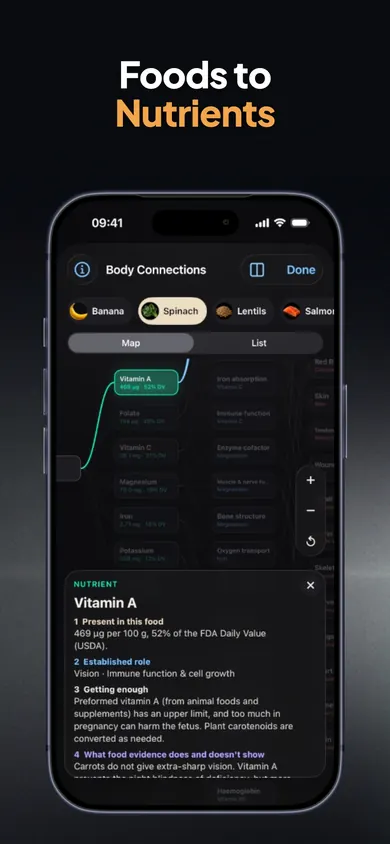
- From food to nutrient. Pick one of 44 everyday foods and see the nutrients it contains.
- From nutrient to job. Each nutrient's established role, and the body place where it happens.
- Missing data stays missing. Values come from USDA FoodData Central and gaps are never shown as zero.
There's also a camera tool: photograph an ingredient list and the app reads it on your device.
How to run a food label lesson in 3 steps
- Pick four packages you already own. Two of the same kind (two cereals) and two different (crackers, a drink).
- Teach the one skill the flowchart gave you. Ten minutes, real boxes, they hold the package and read it out.
- End with a "why" question. Why is fibre on there? What does iron do? For teens, look it up together in Body Unpacked; for younger kids, a library book works.
Read, compare, then ask why. That's the whole method.
Food label questions parents ask
At what age can kids learn to read food labels?
Any child who can read can start with the ingredients list. Serving size works once they can multiply by two or three, and Percent Daily Value makes sense once they've met percentages in school. Start with what they can already do, not with a birthday.
What is the most important part of a food label for kids?
Serving size, because every other number on the label is for one serving. MedlinePlus, NIH (2024) says to check it first; if you eat two servings, you double everything.
How do you explain % Daily Value to a child?
Say it's how much of a whole day's worth one serving gives you, on a 2,000-calorie day. The NIH Office of Dietary Supplements calls foods with 20% DV or more a high source of a nutrient, and the FDA, which designs the U.S. label (2024) treats 5% or less as low. Two numbers to remember: 5 and 20.
Why are ingredients listed in that order?
Ingredients are listed in order of weight, biggest first (NHS (reviewed 2026)). If sugar is in the first three, there's a lot of it. Kids find this one easy and satisfying.
Should kids count calories on labels?
We don't recommend making calories the lesson. Comparing what two foods contain, without calling one good and one bad, teaches the skill without the guilt. If you're worried about a child's eating, talk to their doctor.
Is Body Unpacked suitable for kids?
It's rated 13+ on the App Store, so it suits teens and the adults teaching them. For younger kids, use the flowchart on this page with real packages at the kitchen table.
Label lesson tools compared
Real packages
Free, concrete, any age. Can't tell you what a nutrient does.
Printed worksheets
Good for a classroom; easy to forget once the sheet's done.
Body Unpacked
Free, 13+, offline. Connects a food to nutrients and the body. Its listing describes no barcode scanner or food scores.
One limitation to know: Body Unpacked's content is checked by us against its cited public sources and hasn't been independently reviewed by a clinician. Its illustrations are simplified artwork. Who should pick something else: if you want a barcode scanner or meal tracker, use a dedicated nutrition-tracking app. One design decision we made: the Compare screen has no scores and no "healthier" rankings, because the goal is understanding, not a verdict.
This is general information, not medical advice. Talk to your clinician.
Try it tonight
Grab two cereal boxes after dinner. For the "why" questions, try Body Unpacked tonight, free on the App Store.

Updated November 2026
Related
- Body Unpacked: a human body and nutrition atlasFollow a food into your body: pick spinach, tap iron, see its job and where it happens. A sourced human body and nutrition app for iPhone.
- A human body app for homeschool, with a ready 15-minute lessonFor homeschool parents teaching the human body to tweens and teens: a 15-minute lesson you can run tonight, and three apps compared from their listings.
- Best human body app for beginners: four App Store listings comparedWhat's the best human body app for beginners? Four iPhone apps compared from their App Store listings: what's free, what it costs, and who each one suits.
- Digestive system vocabulary list: 18 terms in the order food meets themA digestive system vocabulary list in the order food travels, from saliva to rectum, with plain definitions from the NIH and a self-check ring.