What do vitamins do? The short answer
Vitamins are 13 nutrients your body needs in small amounts to grow and work normally, each with its own job, from clotting blood (K) to turning food into energy (the B vitamins). Four are fat-soluble and stored in the body (A, D, E, K); nine are water-soluble and mostly not stored, except B12 (MedlinePlus, NIH, reviewed January 2025).
This is general information, not medical advice. Talk to your clinician before starting a supplement.
All 13 vitamins and what they do
Functions summarised from MedlinePlus (2025); extra notes linked individually.
- A
Vitamin A fat-soluble
Helps form and maintain healthy teeth, bones, soft tissue, mucous membranes and skin.
- B1
Thiamine (B1) water-soluble
Helps the body's cells change carbohydrates into energy.
- B2
Riboflavin (B2) water-soluble
Works with the other B vitamins; important for body growth and red blood cell production.
- B3
Niacin (B3) water-soluble
Helps maintain healthy skin and nerves.
- B5
Pantothenic acid (B5) water-soluble
Essential for the metabolism of food.
- B6
Pyridoxine (B6) water-soluble
Helps form red blood cells and maintain brain function.
- B7
Biotin (B7) water-soluble
Essential for metabolizing proteins and carbohydrates, and for making hormones and cholesterol.
- B9
Folate (B9) water-soluble
Works with vitamin B12 to help form red blood cells.
CDC: anyone who could become pregnant should get 400 mcg of folic acid daily to help prevent neural tube defects (2026).
- B12
Cobalamin (B12) water-soluble
Important for metabolism; helps keep blood and nerve cells healthy.
Found naturally only in animal foods. Many adults over 50 absorb less from food, and metformin may lower levels (NIH ODS, 2023).
- C
Vitamin C water-soluble
An antioxidant that promotes healthy teeth and gums; essential for wound healing.
Adults: 90 mg a day for men, 75 mg for women (NIH ODS).
- D
Vitamin D fat-soluble
Helps the body absorb calcium for healthy teeth and bones.
Skin makes less with age, darker skin and little sun; it isn't made through a window (NIH ODS).
- E
Vitamin E fat-soluble
An antioxidant that helps the body form red blood cells and use vitamin K.
- K
Vitamin K fat-soluble
Needed for blood to clot normally.
Fat-soluble vs water-soluble vitamins
| Fat-soluble | Water-soluble | |
|---|---|---|
| Which | A, D, E, K | C and the eight B vitamins |
| Stored? | Yes: liver, fatty tissue, muscles | Mostly not; B12 is the exception |
| What that means | Too much can build up | Needed more regularly from food |
Honest limits of this list
- One line per vitamin is a summary, not the full story. Each vitamin has more roles than fit here.
- We left out minerals (iron, calcium, zinc and others) to keep this a vitamin glossary.
- The situations in the tool cover common, well-documented cases only. Your doctor knows your full picture.
- Body Unpacked itself is checked by us against its cited public sources and has not been independently reviewed by a clinician, as its App Store listing says.
How to go deeper in Body Unpacked, in 3 steps
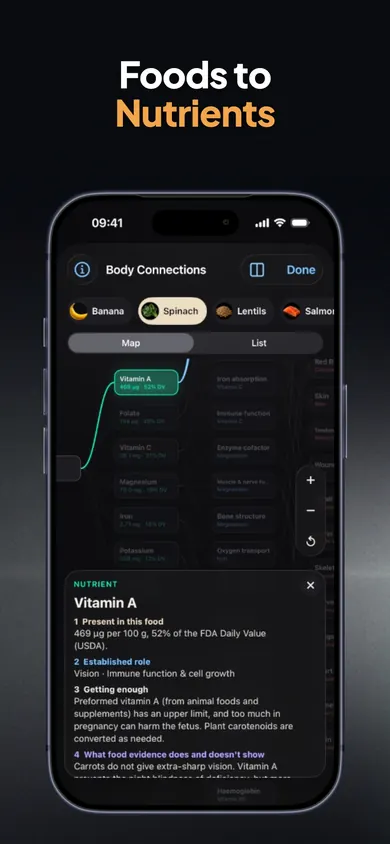
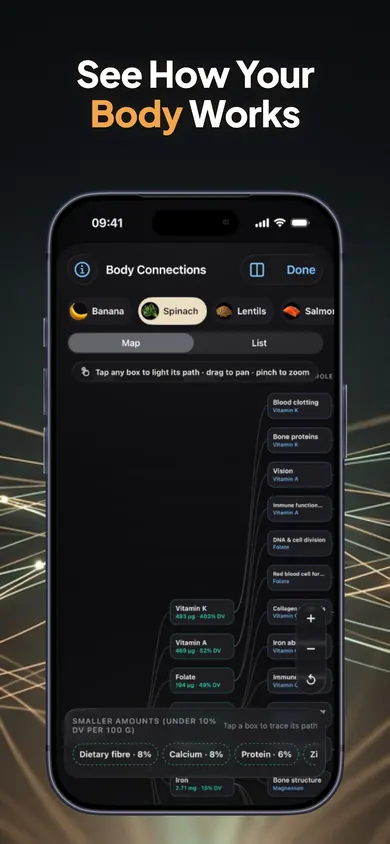
- Pick a food. In Body Connections, choose one of 44 everyday foods, like spinach, and watch it branch into its nutrients.
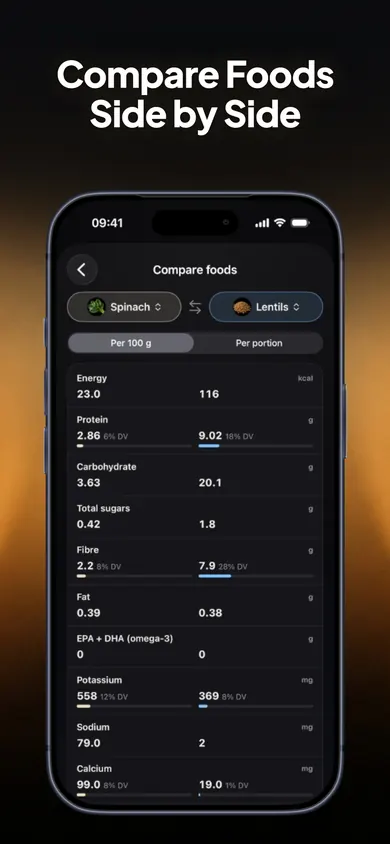
- Tap a nutrient. See its established roles and the body places where they happen. Values come from USDA FoodData Central, and missing data shows as missing, never as zero.
- Follow the journey. 14 Nutrient Journeys show where a nutrient is absorbed, carried, stored and used. B12, for instance, is absorbed at the very end of the small intestine.
A design decision we made: every atlas topic switches between Simple, Standard and Deep dive, so the same page works for a teenager and a nursing student. The app is free to download; no account, no ads, no analytics, and it all works offline.
Who this is not for
If you suspect a deficiency or have symptoms, get tested and advised by a clinician; a glossary can't tell you your levels. If you want a meal planner, calorie counter or supplement recommender, Body Unpacked is none of those. It explains how food and the body connect.
What it looks like
Vitamin questions people ask
How many vitamins are there?
Thirteen: vitamins A, C, D, E and K, and eight B vitamins (thiamine, riboflavin, niacin, pantothenic acid, B6, biotin, folate and B12), as listed by MedlinePlus (NIH, reviewed 2025).
What is the difference between fat-soluble and water-soluble vitamins?
Fat-soluble vitamins (A, D, E and K) are stored in the liver, fatty tissue and muscles. Water-soluble vitamins are not stored, with one exception: vitamin B12 can be stored in the liver for years (MedlinePlus, 2025).
Do I need to take a multivitamin?
Most people don't. The NHS says most people should get all the nutrients they need from a varied and balanced diet, while some people may need supplements. Ask your doctor or pharmacist about your situation.
Can you take too much of a vitamin?
Yes. Some have upper limits for adults from all sources combined, for example 2,000 mg a day of vitamin C (NIH ODS) and 100 mcg (4,000 IU) a day of vitamin D (NIH ODS).
Which vitamin helps the body absorb calcium?
Vitamin D. It helps the body absorb calcium, which you need for healthy teeth and bones (MedlinePlus, 2025).
Does Body Unpacked tell me which supplements to take?
No. It is an education app: it explains what each nutrient does and where in the body it does it, with sources, and gives no individual supplement or medication advice.
Download free on the App Store
249 sourced topics, all 13 vitamins, and the map of where each one works.

Body Unpacked: Health Atlas · Updated November 2026
Related
- Body Unpacked: a human body and nutrition atlasFollow a food into your body: pick spinach, tap iron, see its job and where it happens. A sourced human body and nutrition app for iPhone.
- Which cold remedies actually work? Seven remedies, gradedCold season guide: vitamin C, zinc, honey, saline, antibiotics and more, each graded by what Cochrane, Mayo Clinic and the NHS actually found.
- A human body app for homeschool, with a ready 15-minute lessonFor homeschool parents teaching the human body to tweens and teens: a 15-minute lesson you can run tonight, and three apps compared from their listings.
- Best human body app for beginners: four App Store listings comparedWhat's the best human body app for beginners? Four iPhone apps compared from their App Store listings: what's free, what it costs, and who each one suits.