What are the most common nutrition myths students believe?
The classroom classics are that sugar makes kids hyperactive, frozen vegetables are worse than fresh, detox teas flush out toxins, calcium only comes from dairy and bread is fattening; each one falls apart when you check the source. The sixth card is a trap on purpose: it is true, so students can't win by answering "myth" every time.
But my mum says sugar makes my little brother bounce off the walls.
When researchers hid whether children got sugar or a sweetener, across 23 studies, behavior didn't change on average (Wolraich et al., JAMA (1995)). The authors suggest expectation plays a big part. A small effect in some children can't be ruled out, which is a good thing for students to notice: good evidence says what it can't prove too.
So is frozen broccoli basically junk?
No. In one lab study, frozen produce held vitamins about as well as fresh produce kept in a fridge, sometimes better (Bouzari et al., J Agric Food Chem (2015)). Freshly picked from a garden is a different story from five days in a fridge drawer.
Why do we need fat if fat is bad?
Because "fat is bad" was never quite right. A small amount is essential and helps the body absorb vitamins A, D and E (NHS (2023)).
Where the answers come from in the app
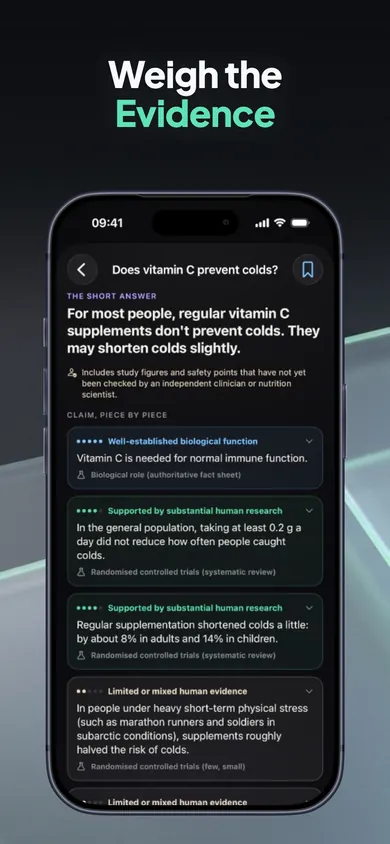
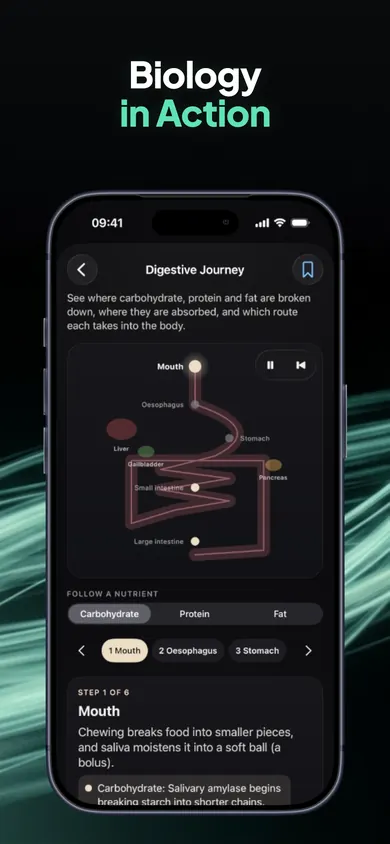
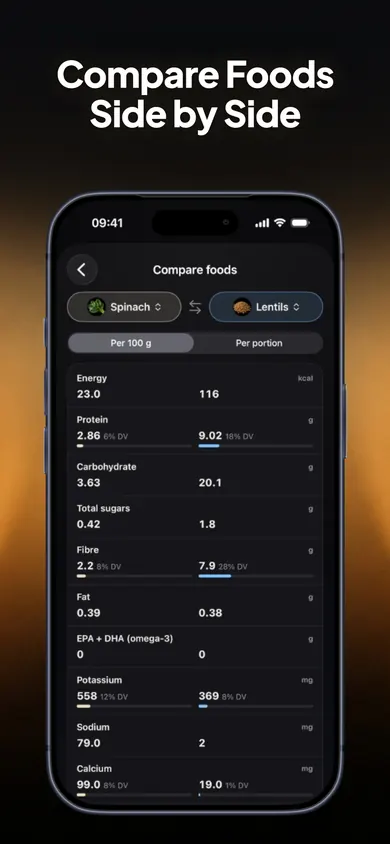
Honest limits
The worksheet is ours, written for this page; it is not inside the app. Body Unpacked is general health education: it does not diagnose, treat or replace a qualified professional, gives no individual supplement or medication advice, and its content is checked by the developer against cited public sources, not independently reviewed by a clinician. Its illustrations are simplified artwork made with AI-assisted tools. It runs on iPhone only, so it works best projected from the teacher's phone or used by students who already have one.
Who should pick something else: if you need a full nutrition curriculum with standards alignment, use your district's materials or a dedicated curriculum provider. This is a 15-minute starter, not a unit.
A mini story: Period 3, Thursday
Okay class, six cards. Hands up if sugar makes you hyper.
Most hands go up. Card one flips: Myth. A groan, then an argument, which is the point. By card six, someone shouts "myth!" before reading it, and it says Fact. The room goes quiet for a second. That second is the lesson.
One design decision we made: every answer names its source and year. Students should leave able to ask "says who, and when?", not just with six new facts to memorize.
The 15-minute lesson plan
- Minutes 0 to 5: project this page and flip the six cards as a class vote.
- Minutes 5 to 12: hand out the printed worksheet; students mark M or F and write one reason each.
- Minutes 12 to 15: read the answer key, then ask: which source would you trust most, and why?
Nutrition myths: myth or fact? Name: ______________________
| # | Claim | Circle | Your reason |
|---|---|---|---|
| 1 | Sugar makes kids hyperactive. | M / F | |
| 2 | Frozen vegetables are less nutritious than fresh. | M / F | |
| 3 | Detox teas and cleanses flush out toxins. | M / F | |
| 4 | Only dairy foods have calcium. | M / F | |
| 5 | Bread and pasta are fattening. | M / F | |
| 6 | Your body needs some fat. | M / F |
Bonus: find one health claim on a food package at home. Who is making the claim, and how could you check it?
Answer key (teacher)
- 1. Myth. A meta-analysis of 23 blinded studies found sugar did not affect children's behavior or thinking; a small effect in some children can't be ruled out (Wolraich et al., JAMA (1995)).
- 2. Mostly myth. In a UC Davis study of eight fruits and vegetables, frozen vitamin levels were comparable to fresh and sometimes higher; beta-carotene dropped in some (Bouzari et al., J Agric Food Chem (2015)).
- 3. Myth. A review found no compelling research supporting detox diets for removing toxins (NIH NCCIH (2025)).
- 4. Myth. Kale, broccoli, bok choy, canned sardines and salmon with bones, and many fortified foods contain calcium (NIH Office of Dietary Supplements (2023)).
- 5. Myth. Gram for gram, starchy foods contain fewer than half the calories of fat. Watch the butter and sauces (NHS (2023)).
- 6. Fact. A small amount of fat is essential: it supplies fatty acids the body can't make and helps absorb vitamins A, D and E (NHS (2023)).
From the Honest Little Apps health hub · Updated November 2026
This worksheet vs a typical myth list
| This page | Typical list | |
|---|---|---|
| Every answer sourced | Named source and year | Often none |
| Includes a true claim | Yes, card six | Usually all myths |
| Says what evidence can't prove | Yes | Rarely |
| Sign-up to download | None | Often an email gate |
Nutrition myths worksheet: teacher questions
What are common nutrition myths for students?
Classroom favorites include sugar making kids hyperactive, frozen vegetables being less nutritious than fresh, detox teas flushing out toxins, calcium coming only from dairy and bread being fattening. Each is checked against a named source on this page, for example Wolraich et al., JAMA (1995) for sugar.
Is there a free nutrition myths worksheet with answers?
Yes. Use the Print the worksheet button on this page. It prints a one-page student sheet and an answer key with sources, with no email or sign-up.
Does sugar really make kids hyper?
Blinded studies say no on average: a 1995 meta-analysis found sugar does not affect the behavior or cognitive performance of children, and suggested parents' strong belief may come from expectation (Wolraich et al., JAMA (1995)).
Are frozen vegetables as healthy as fresh?
Often, yes. Frozen produce had vitamin content comparable to, and occasionally higher than, fresh produce stored in a fridge, though beta-carotene fell in some vegetables (Bouzari et al., J Agric Food Chem (2015)).
What grade level is this worksheet for?
It is written for middle and high school health or science classes, roughly ages 11 to 18. Younger students can do the flip cards as a class with the teacher reading.
Is Body Unpacked suitable for students?
It is a general health-education app with no account, no ads and no analytics, and everything works offline. It is not a substitute for advice from a qualified professional, and its content has not been independently reviewed by a clinician.
Get Body Unpacked free
Put the Evidence Lens on the projector for the next myth a student brings in. This is general information, not medical advice. Talk to your clinician.

Related
- Body Unpacked: a human body and nutrition atlasFollow a food into your body: pick spinach, tap iron, see its job and where it happens. A sourced human body and nutrition app for iPhone.
- Free food nutrient lookup tools, checkedWhere to look up the nutrients in a food for free, checked November 2026: USDA FoodData Central, NIH fact sheets, an offline tool and more.
- A human body app for homeschool, with a ready 15-minute lessonFor homeschool parents teaching the human body to tweens and teens: a 15-minute lesson you can run tonight, and three apps compared from their listings.
- Vitamins and what they do: all 13 in five minutesAll 13 vitamins and what each one does, in plain English, sourced to NIH. Pick your situation to see which ones matter most for you.