Where can I look up the nutrients in a food for free?
Where can you look up nutrients in food for free?
The best free nutrient lookup is USDA FoodData Central: it is free, needs no account, and its data are public domain. For a quick reference on one nutrient, the NIH Office of Dietary Supplements fact sheets list top food sources with amounts and %DV. Here's the full roundup; we checked each online source on November 3, 2026.
1. USDA FoodData Central
The main US food composition database, run by USDA's Agricultural Research Service and hosted by the National Agricultural Library. It holds five data types: Foundation Foods (updated twice a year, April and October), SR Legacy (historical data, final update in 2018), FNDDS survey foods (every two years), experimental foods, and Branded Foods from product labels (monthly).
2. USDA "What's In The Foods You Eat" Search Tool
A downloadable Excel workbook (2021-2023 edition) built on the FNDDS database used to analyze what Americans report eating. It shows nutrient profiles for commonly eaten foods with familiar portion sizes you can adjust.
3. NIH Office of Dietary Supplements fact sheets
One fact sheet per vitamin or mineral, each with a table of food sources. The iron sheet, for example, lists ½ cup of boiled spinach at 3 mg (17% DV) and a serving of fortified breakfast cereal at 18 mg (100% DV).
4. The Nutrition Facts label
Already in your hand for packaged food. It gives amounts and %DV per stated serving for the nutrients required on the label.
5. Body Unpacked (we make this one)
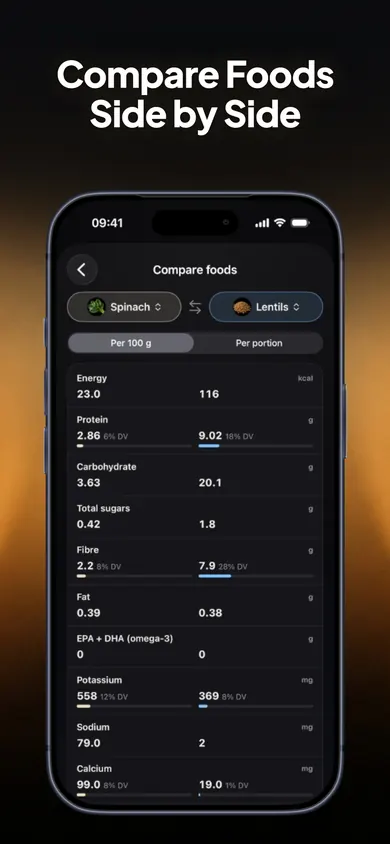
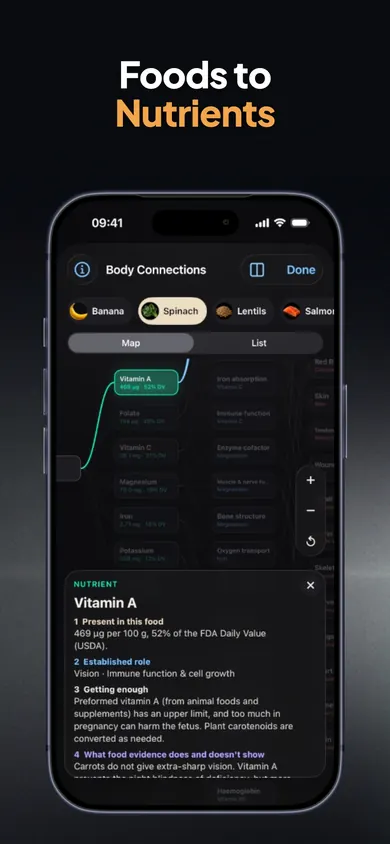
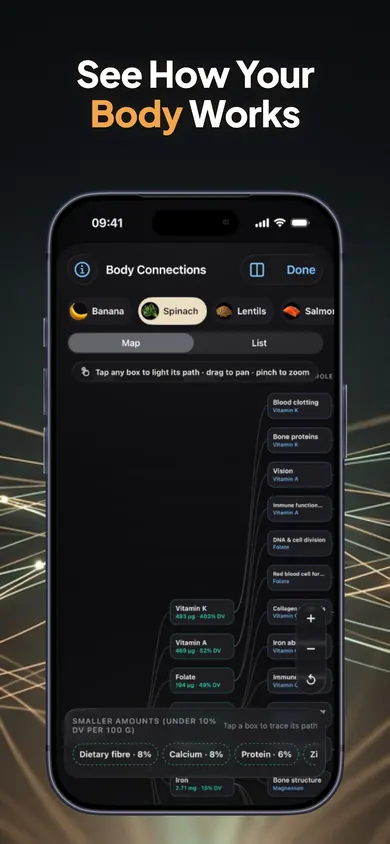
Our iPhone app takes 44 everyday foods and shows 14 nutrients for each, using USDA FoodData Central SR Legacy values. Every %DV shows its amount basis and the FDA reference it uses; missing data shows as missing, never as zero. Then it goes one step further than a database: it draws where each nutrient works in the body.
A nutrient number is only useful when you know which food entry and which portion it came from.
So what can't Body Unpacked do?
Honest limits
- It covers 44 foods and 14 nutrients in the comparison and connections views. For anything else, use FoodData Central.
- It doesn't log what you eat or add up a day. The optional food and body journal is for notes, not tracking totals.
- Content is checked by the developer against the cited public sources and has not been independently reviewed by a clinician.
- It gives no individual supplement or medication advice, and the illustrations are simplified artwork made with AI-assisted tools.
This is general information, not medical advice. Talk to your clinician.
Who should use something else?
Who these free tools are not for
If you need to track daily totals against a target, a food-logging app does that and none of these tools will. If you're on a medically prescribed diet, such as a potassium or protein limit, the numbers that matter are the ones your dietitian or clinician sets for you. And if you need a specific branded product, check its label or FoodData Central's Branded Foods data, because Body Unpacked doesn't include brands.
Show me the app version.
Body Unpacked's comparison and connections screens
Can you walk me through a real lookup?
A mini-story: the 9 PM nutrition assignment
A class assignment asks for the potassium in five foods, with sources. The first search result is a recipe blog with a number and no citation. Instead: open FoodData Central on a laptop, search "spinach raw", pick the SR Legacy entry, note 558 mg per 100 g and the FDC ID. Four more foods, ten minutes, every number traceable.
On the bus the next morning, the question changes from "how much?" to "what does potassium actually do?". That's the part a database can't answer, and the part we built Body Unpacked for: tap spinach, tap potassium, and see its established roles and where in the body they happen, each with its source.
Give me the short version.
Free nutrient lookup tools compared
| Tool | Foods | Account | Offline | Best on | Best for |
|---|---|---|---|---|---|
| FoodData Central | Very large, five data types | No | No | Desktop | Any food, any nutrient |
| What's In The Foods You Eat | Commonly eaten US foods | No | Yes | Desktop (Excel) | Familiar portions |
| NIH ODS fact sheets | Top sources per nutrient | No | No | Any | "What's high in X?" |
| Nutrition Facts label | That one package | No | Yes | In the store | Packaged food |
| Body Unpacked | 44 everyday foods | No | Yes | iPhone | What nutrients do, and where |
Our one design decision worth knowing: Body Unpacked compares foods without scores or "healthier" badges. Two columns of what each food contains, and the rest is your call.
A few more questions.
Nutrient lookup FAQ
What is the best free tool to look up nutrients in food?
For any single food, USDA FoodData Central. It's free, needs no account, and covers lab-analyzed foods, survey foods and branded products. It's easiest on a computer; on a phone you only get a basic view of search results.
Is USDA FoodData Central free to use?
Yes. The site is free to search, and the data are public domain under CC0 1.0. USDA only asks that you name FoodData Central as the source.
Can I look up nutrients offline?
Yes: USDA's What's In The Foods You Eat Search Tool (2021-2023) is a downloadable Excel file that works without internet. Body Unpacked also works fully offline for its 44 foods.
Why do two websites give different numbers for the same food?
They often use different data types or samples: a raw versus cooked food, an older SR Legacy entry versus a newer Foundation Foods analysis, or a branded label. Always check which entry and which portion a number refers to.
What does %DV mean on a nutrient number?
Percent Daily Value compares an amount to a reference intake. For example, the NIH Office of Dietary Supplements gives the Daily Value for iron as 18 mg for adults and children age 4 and older. A %DV is a general reference, not a personal target.
Can Body Unpacked tell me how much of a nutrient I need?
No. Body Unpacked is educational. It shows what foods contain and what nutrients do, and gives no individual supplement or medication advice.
Make it a habit with Body Unpacked
Look up the number at FoodData Central. Then open Body Unpacked to see what that nutrient actually does.

Body Unpacked on the App Store · Updated November 2026
Related
- Body Unpacked: a human body and nutrition atlasFollow a food into your body: pick spinach, tap iron, see its job and where it happens. A sourced human body and nutrition app for iPhone.
- A human body app for homeschool, with a ready 15-minute lessonFor homeschool parents teaching the human body to tweens and teens: a 15-minute lesson you can run tonight, and three apps compared from their listings.
- Nutrition myths worksheet for students, with answer keySix nutrition claims for a 15-minute class: flip the cards, then print a myth-or-fact worksheet with a sourced answer key. Free, no sign-up.
- Vitamins and what they do: all 13 in five minutesAll 13 vitamins and what each one does, in plain English, sourced to NIH. Pick your situation to see which ones matter most for you.