Is spinach a good source of iron?
Short answer?
Yes, spinach is a decent iron source, about 3 mg per half cup cooked, but its plant (nonheme) iron is absorbed less readily than the heme iron in meat and seafood. It's neither the superfood of cartoons nor the fraud of internet myth-busting.
Spinach's iron is real. How much of it you absorb depends on the rest of the plate.
Six spinach and iron myths, checked
Our transcript format: the myth as people say it, then what the sources say. Sources are the NIH Office of Dietary Supplements iron fact sheet (checked November 2026) and two peer-reviewed papers.
"Spinach is the best source of iron."
In the NIH serving table, ½ cup boiled spinach (3 mg) ties with ½ cup boiled lentils and ½ cup firm tofu. A cup of canned white beans has 8 mg, 3 oz of cooked oysters 8 mg, and a fortified breakfast cereal can carry 18 mg, the full Daily Value.
"Actually, spinach barely has any iron."
The overcorrection. Per the NIH servings, half a cup of cooked spinach (3 mg) beats 3 oz of braised bottom round beef (2 mg) on amount.
"Iron is iron. It all gets absorbed the same."
The NIH fact sheet says heme iron (meat, seafood, poultry) has higher bioavailability than nonheme iron (plants, fortified foods), and puts iron bioavailability at roughly 14% to 18% from mixed diets and 5% to 12% from vegetarian diets.
"The oxalate in spinach blocks all its iron."
Less clear than it sounds. A 2008 stable-isotope study in the European Journal of Clinical Nutrition found added oxalic acid did not change iron absorption from a kale meal. Absorption from the spinach meal was 24% lower than from kale, but not statistically significant, and spinach was higher in calcium and polyphenols. Small study: 13 women completed it.
"What you eat it with doesn't matter."
It does. The NIH fact sheet says vitamin C enhances absorption of nonheme iron, while phytate (grains, beans), some polyphenols and calcium can reduce it.
"Popeye happened because of a misplaced decimal point."
A 2014 paper in Social Studies of Science used the decimal-point story itself as its example of an "academic urban legend": a tale repeated in respectable publications with weak sourcing. The myth about the myth is the myth.
Spinach and iron FAQ
How much iron is in spinach?
The NIH Office of Dietary Supplements iron fact sheet lists ½ cup of boiled, drained spinach at 3 mg of iron, 17% of the 18 mg Daily Value.
Does spinach have more iron than beef?
Per the serving sizes in the NIH iron fact sheet, yes: ½ cup boiled spinach has 3 mg, and 3 ounces of braised bottom round beef has 2 mg. But beef's heme iron is absorbed more readily than spinach's nonheme iron.
Why is iron from spinach harder to absorb?
Plant iron is nonheme iron, which is less bioavailable than the heme iron in meat and seafood, and more affected by other parts of the meal. The NIH fact sheet names phytate and certain polyphenols as inhibitors and calcium as possibly reducing both kinds.
Does vitamin C help you absorb iron from spinach?
The NIH Office of Dietary Supplements says vitamin C (ascorbic acid) enhances the bioavailability of nonheme iron, the kind in spinach and other plants.
Is cooked or raw spinach better for iron?
Cooked spinach packs more iron per half cup because cooking shrinks the leaves: half a cup of cooked spinach is a lot more leaves than half a cup of raw. Compare foods per 100 g or per stated serving, never by eye.
Should I take an iron supplement instead?
That's a question for a clinician, ideally with a blood test. Body Unpacked gives no individual supplement advice.
A mini-story: the Tuesday salad
I've gone mostly vegetarian. I'm eating a huge spinach salad every day for the iron. Enough?
The NIH's 3 mg is for half a cup of cooked spinach, and raw leaves cook down a lot, so a big bowl of raw salad may be less spinach than it looks. And plant iron absorbs less readily, which is why the NIH lists vitamin C as a helper.
So what changes?
The plate, not the spinach: add beans or lentils, something with vitamin C, and if you're worried about being low, ask a clinician about a blood test instead of guessing. Food tables can't tell you your own iron status.
How Body Unpacked shows this, in 3 steps
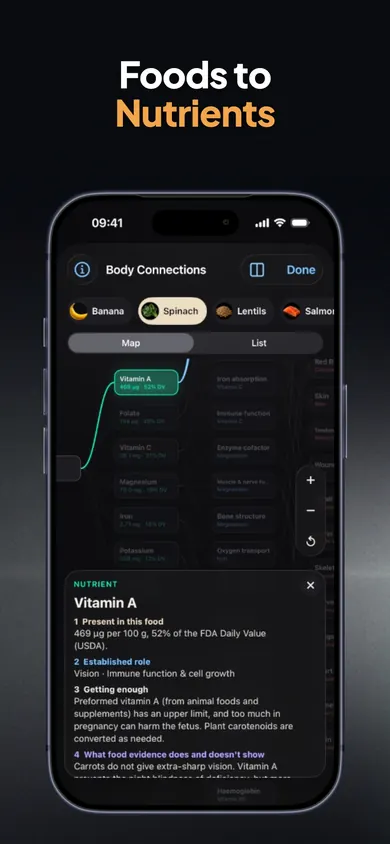
- Pick spinach in Body Connections. A graph draws itself from the food to its nutrients, with each %DV and its FDA reference basis.
- Tap iron. See its established roles and the places in the body where they happen, with the source for each.
- Follow the iron journey, one of 14 nutrient journeys on an animated body map: where it's absorbed, what carries it, where it's stored and how the gut controls how much comes in.
Build an iron plate (NIH serving data)
Tap foods to add them. We add up the milligrams from the NIH serving table and mark which iron is heme and which is nonheme. The %DV uses the 18 mg Daily Value, a general reference, not your personal need.
Heme vs nonheme iron at a glance
Heme iron
Found in: meat, seafood, poultry.
Absorption: higher, and less affected by the rest of the meal.
Example: 3 oz beef, 2 mg.
Nonheme iron
Found in: spinach, beans, lentils, tofu, fortified foods (and meat too).
Absorption: lower; helped by vitamin C, reduced by phytate, some polyphenols and calcium.
Example: ½ cup cooked spinach, 3 mg.
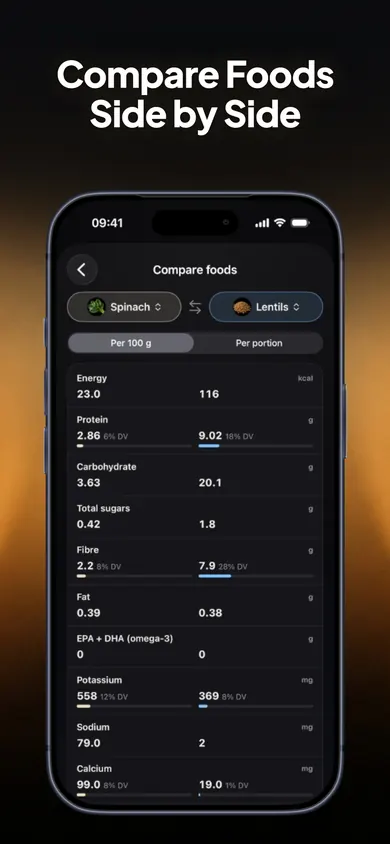
One design decision in Body Unpacked: it never ranks foods as "healthier". A side-by-side table of what each contains is more honest than a score, and spinach is the perfect example of why one number misleads.
Honest limits
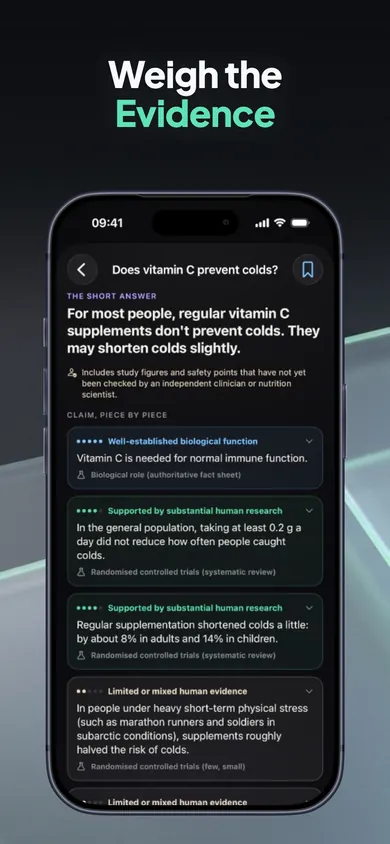
Body Unpacked is education, not diagnosis: it gives no individual supplement or medication advice, its content is checked by the developer against cited sources rather than independently reviewed by a clinician, and it covers 44 foods. If you need a diet plan for low iron, that's a clinician or dietitian's job.
This is general information, not medical advice. Talk to your clinician.
Try it tonight: follow spinach into your body
Pick spinach, tap iron, and watch where it goes. Free on iPhone, offline, no account.

Body Unpacked on the App Store · Updated November 2026
Related
- Body Unpacked: a human body and nutrition atlasFollow a food into your body: pick spinach, tap iron, see its job and where it happens. A sourced human body and nutrition app for iPhone.
- Best human body app for beginners: four App Store listings comparedWhat's the best human body app for beginners? Four iPhone apps compared from their App Store listings: what's free, what it costs, and who each one suits.
- Digestive system vocabulary list: 18 terms in the order food meets themA digestive system vocabulary list in the order food travels, from saliva to rectum, with plain definitions from the NIH and a self-check ring.
- Do you really need 8 glasses of water a day? Six claims flippedFlip six water claims to see what Mayo Clinic, the NHS and the research say: the 8x8 rule, coffee, food, pee colour and drinking too much.