
How can you tell if you're losing muscle on GLP-1?
You can't tell from the scale alone; the honest home answer is to track what your muscles can do (chair stands, the loads you lift, everyday tasks) on a steady schedule, and bring that record to your clinician, who can decide whether you need a body-composition scan.
Below, a short annotated tour of where those numbers live in Sturdy. Weight tells you how much; function tells you what you kept.
 1
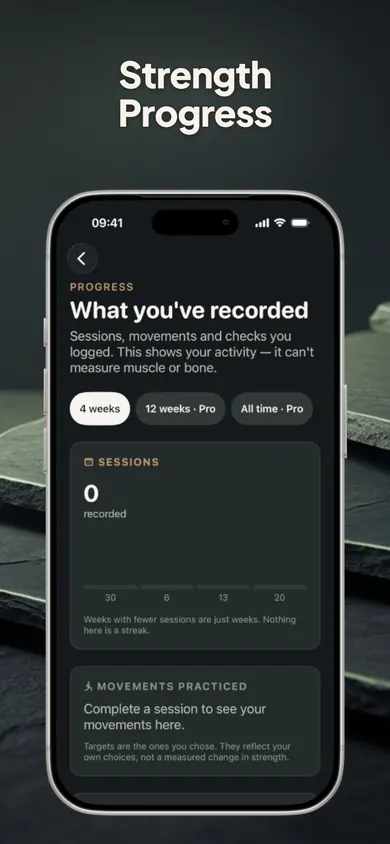
Progress says what it can't do
Sessions, movements, effort and loads you recorded. The screen itself says it can't measure muscle or bone, and we wrote that line on purpose.
 2
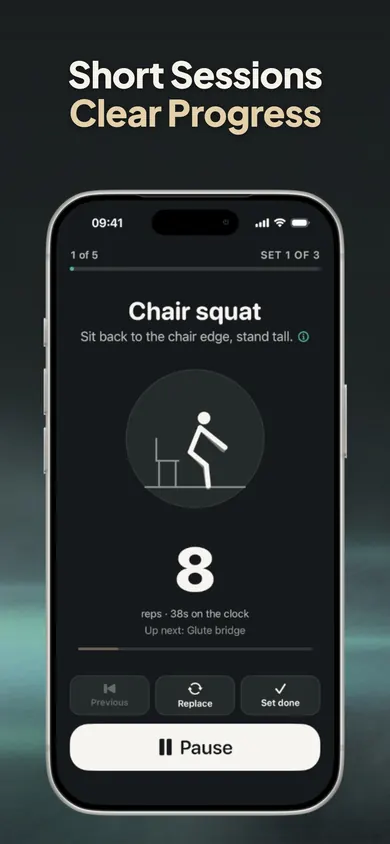
Loads and reps, kept per movement
The guided player shows each movement with a timer and rep guidance. What you log becomes the trend you can compare month to month.
 3
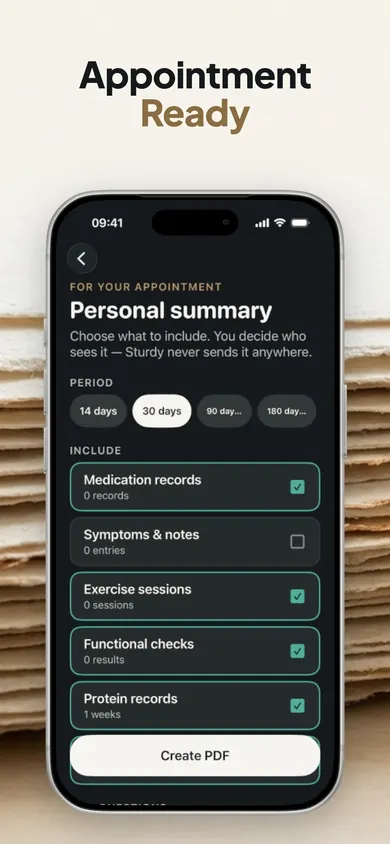
A summary you choose to share
Tick functional checks, sessions and protein, then make a 30-day PDF. Everything is marked as self-recorded.
Five tracking mistakes on GLP-1, and the fix
Treating the scale as the whole story.
Fix: keep weighing if your clinician wants it, but add one strength number. A joint advisory from four obesity and nutrition societies (2025) lists strength training and adequate protein to preserve lean mass, so track both.
Reading a home body-fat scale as a muscle measurement.
Fix: treat it as a rough trend at best. Research trials measure body composition with DXA scans, as the STEP 1 body-composition substudy (2021) did. Ask your clinician whether a measurement is worth it for you.
Testing only on a bad day.
Fix: same chair, similar time of day, every four weeks. Write down how you slept and when you last ate.
Skipping strength because walking feels like enough.
Fix: the CDC adult activity guidelines (2023) ask for muscle-strengthening on at least 2 days a week, working legs, hips, back, abdomen, chest, shoulders and arms.
Letting protein slide when appetite drops.
Fix: log it, even roughly. Sturdy takes grams from a label, hand-portion estimates (labeled as estimates) or simple meal checkmarks. You set the target, ideally with your care team.
Who this page is not for
- Anyone with dizziness, a recent fall, fracture or injury, or pain on standing. Talk to your clinician before any test or exercise.
- People who want a muscle-loss verdict. Neither this page nor Sturdy can give one.
- Anyone not taking GLP-1 or other weight-management medication under medical care; Sturdy is built for adults who are.
Muscle on GLP-1: questions
Can you lose muscle on Ozempic, Wegovy or Mounjaro?
Weight lost on these medicines is not all fat. A joint advisory from four obesity and nutrition societies (2025) names muscle and bone loss as a challenge with GLP-1 medicines and lists adequate protein and strength training to preserve lean mass among its priorities. Ask your prescriber what applies to you.
How do doctors actually measure muscle?
In research, body composition is usually measured with a DXA scan; for example, the STEP 1 body-composition substudy (2021) used DXA in 140 participants. Whether you need a scan is a question for your clinician. At home, you can track what your muscles can do.
Is the 30-second chair stand safe to try?
The CDC STEADI 30-Second Chair Stand (2017) is a simple test: sit in the middle of a chair, arms crossed, and stand up fully and sit back down as many times as you can in 30 seconds. Use a solid chair against a wall, and skip it if you have dizziness, pain or a recent injury, or haven't been cleared to exercise.
How often should I re-test?
Pick a rhythm you will keep, such as every four weeks, with the same chair at a similar time of day. Writing down the conditions matters as much as the number, because a tired afternoon will score lower than a fresh morning.
What should I do if my number drops?
Bring it to your clinician with your notes, rather than changing your medication or diet on your own. Sturdy can make a 30-day PDF summary with your check-ins, sessions, protein and questions, clearly marked as self-recorded.
Does Sturdy tell me if I'm losing muscle?
No. Sturdy shows your own history of sessions, loads, protein and check-ins with no scores, age norms or medical conclusions. Its progress screen says plainly that it can't measure muscle or bone.
Ways to check, compared
We compared five common ways people try to check muscle while losing weight. Pick one function test and one strength log, and keep them boring and regular.
At-home strength moves like sit-to-stands, wall press-ups and curls with filled water bottles come straight from the NHS (2024) strength exercise page. This is general information, not medical advice. Talk to your clinician.
Start on your iPhone
Start on your iPhone: log one chair-stand check-in and one short session this week, then look again in four.

Sturdy: Strength on GLP-1 on the App Store · Updated November 2026
Related
- Sturdy: strength and protein on GLP-1Sturdy plans short strength sessions and logs protein for adults on prescribed GLP-1 medication. Private, no account, free on iPhone.
- Finding a GLP-1 personal trainer near you: a 5-step vetting guideLooking for a personal trainer who understands GLP-1 medication? Verify credentials free, sort their answers, and know what to track between sessions.
- GLP-1 workouts during the holidays: a 6-week plannerOn GLP-1 medication and the holidays are here? Plan short strength sessions for six weeks around travel and hosting, with a live counter.
- Exercising with knee pain on GLP-1: six myths, checkedKnee pain and on Wegovy, Zepbound or another GLP-1? Six common exercise myths checked against NIH, NHS, CDC and the STEP 9 trial. Free tool inside.