
Can you exercise with knee pain on GLP-1 medication?
Usually yes, carefully and with your clinician's go-ahead: for knee osteoarthritis, the NIH's arthritis institute says exercise can reduce joint pain and stiffness and build muscle strength, as long as you start slowly and stop for warning signs. What changes on a GLP-1 medicine is less the knee than the context: you may be eating less, feel low on energy some days, and be losing weight quickly. This is general information, not medical advice. Talk to your clinician.
Updated November 2026 · Facts from NIH, NHS, CDC and a peer-reviewed trial, linked in each line.
Dear sore knee,
We wrote Sturdy for adults on prescribed GLP-1 and other weight-management medication, and knees come up more than anything else. So this page is a letter, plain and short, about six things people tell themselves before they skip another leg day. Each one gets a verdict and a source.
Knee pain and GLP-1: six myths vs facts
Myth
“If my knee hurts, I should rest it until the weight comes off.”
Rest has its place after an injury or a flare. But for osteoarthritis, NIAMS, part of the NIH lists exercise among the main treatments: it can reduce joint pain and stiffness and increase flexibility, muscle strength and endurance. Waiting for the scale before you move can cost you the muscle that supports the knee.
Half true
“The medication will fix my knee on its own.”
Weight does matter: NIAMS notes that managing weight reduces stress on joints, especially knees and hips. In the STEP 9 trial (New England Journal of Medicine, 2024), 407 adults with obesity and knee osteoarthritis lost 13.7% of their weight on semaglutide against 3.2% on placebo, and pain scores dropped further too. But everyone in that trial also got counseling on physical activity and diet, and the placebo group's pain improved as well. The trial tested medicine plus a lifestyle program, not medicine instead of one.
Myth
“Squats are off the table forever.”
NIAMS recommends strengthening with weights or exercise bands and suggests avoiding repetitive motions such as frequent bending. That points to smarter squats, not none: a chair to sit back to, a shallower range, fewer reps. Change the depth, keep the pattern. A physical therapist can set your range.
Myth
“Pain during the session means it's working.”
Some effort is fine; sharp or worsening pain isn't a badge. The NHS knee pain advice (reviewed 2023) says to get advice urgently if your knee is very painful, can't bear weight, is badly swollen or changed shape, or locks, gives way or painfully clicks. Those are reasons to stop and call, not push.
Fact
“I can strengthen my legs without a gym.”
The CDC adult activity guidelines (2023) ask for muscle-strengthening on 2 or more days a week across all major muscle groups, and NIAMS mentions bands as well as weights. A sturdy chair, a wall and a band cover a lot. Two short sessions a week is the bar, not a gym membership.
Fact
“Starting small is the right call.”
NIAMS advises starting any exercise program slowly and giving yourself time to adjust. NIDDK (NIH, 2024) adds that weight-management medicines work best combined with a lifestyle program. Small and steady beats ambitious and sore.
What the knee demo above is showing
Sturdy's listing says you can flag sore areas before a session and those movements are swapped out, mark a movement uncomfortable so it's left out in future, and change difficulty only when you choose. The demo is our illustration of that idea. One design decision behind it: we made skipping a movement a one-tap, no-guilt action, because people with sore joints tend to quit the whole session when a single exercise hurts.
Knee and GLP-1 exercise questions
Can I exercise with knee pain while taking a GLP-1 medicine?
Often yes, but check with your clinician first, especially with new pain, swelling or an injury. NIAMS, part of the NIH says exercise can reduce joint pain and stiffness in osteoarthritis and increase flexibility, muscle strength and endurance, and advises starting slowly.
Will losing weight on semaglutide help my knee pain?
In the STEP 9 trial (New England Journal of Medicine, 2024), adults with obesity and knee osteoarthritis lost 13.7% of body weight on semaglutide versus 3.2% on placebo over 68 weeks, and their WOMAC pain scores fell 41.7 points versus 27.5. Both groups also had counseling on physical activity and a reduced-calorie diet. Your results may differ.
Are squats bad for bad knees?
Not automatically. NIAMS recommends strengthening exercises with weights or bands for osteoarthritis and suggests avoiding repetitive motions such as frequent bending. A physical therapist can help you pick a depth and number of reps that suits your knee.
When should knee pain stop me exercising?
The NHS knee pain advice (reviewed 2023) says to get advice urgently if your knee is very painful, you cannot move it or put weight on it, it is badly swollen or has changed shape, it locks, gives way or painfully clicks, or you have a high temperature with redness or heat around it.
How much strength training is recommended?
For adults in general, the CDC adult activity guidelines (2023) recommend muscle-strengthening activity on 2 or more days a week that works all major muscle groups. Ask your clinician how that applies to you.
Does Sturdy know about my knee?
Only what you tell it. You can flag sore areas before a session and those movements are swapped out, and mark a movement uncomfortable so it is left out in future. Sturdy does not assess joints or give medical advice.
Inside Sturdy
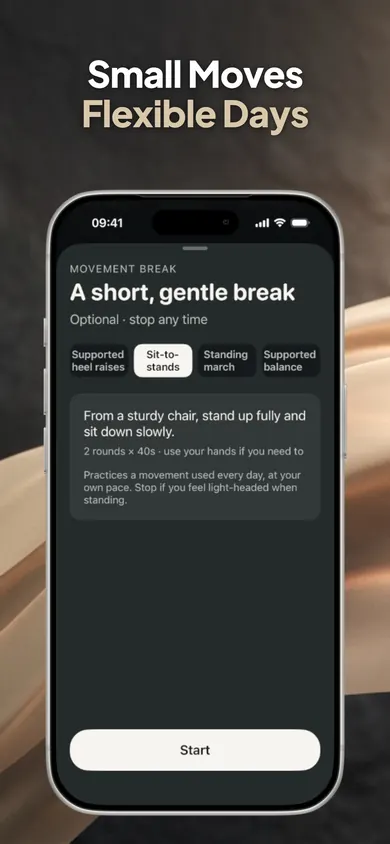
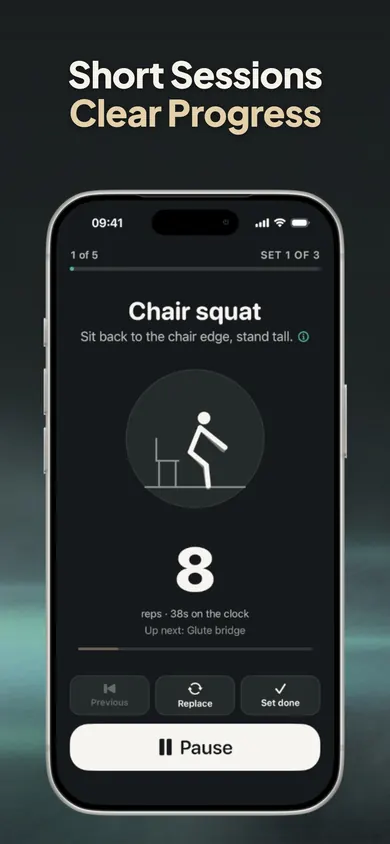
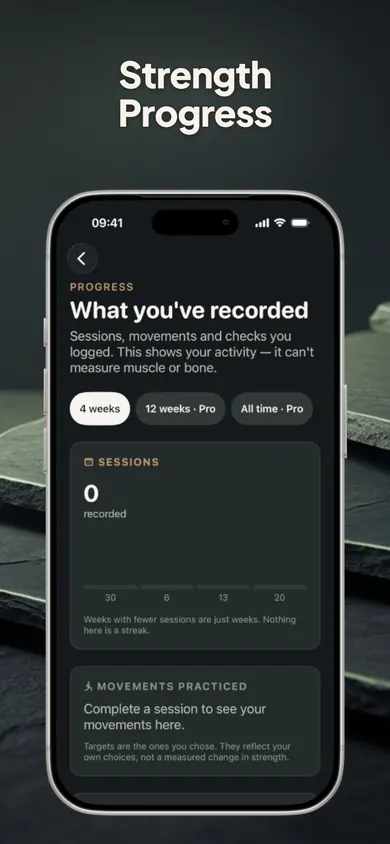
Three ways to train around a sore knee
| Physical therapist | Video workouts | Sturdy | |
|---|---|---|---|
| Assesses your knee | Yes | No | No |
| Skips sore areas | Yes, by judgment | You pause and improvise | Flag before a session |
| Cost | Visit fees or insurance | Often free | Free tier; Pro weekly or yearly |
| Keeps a record | Their notes | No | Sessions, loads, protein, check-ins |
These work together: a PT sets the plan, and a log keeps the days between visits honest.
Who this is not for
If your knee is newly swollen, hot, locking or giving way, skip the apps and see a clinician. If you've had a recent fracture, surgery or dizziness, check with your care team before exercising at all. And if you want someone to watch your form, a physical therapist or qualified trainer will do what no app can. Sturdy is a planner and self-tracking tool; it doesn't diagnose, treat or give medication advice. Free covers weekly planning, all three workout types, the core movement library and sessions up to 30 minutes; Sturdy Pro adds gym-equipment movements, 45-minute sessions and longer progress views.
Take the stairs slowly,
Honest Little Apps
Play free on iPhone
Flag the knee, keep the rest of the session, and keep a record for your next appointment.

Related
- Sturdy: strength and protein on GLP-1Sturdy plans short strength sessions and logs protein for adults on prescribed GLP-1 medication. Private, no account, free on iPhone.
- Finding a GLP-1 personal trainer near you: a 5-step vetting guideLooking for a personal trainer who understands GLP-1 medication? Verify credentials free, sort their answers, and know what to track between sessions.
- GLP-1 workouts during the holidays: a 6-week plannerOn GLP-1 medication and the holidays are here? Plan short strength sessions for six weeks around travel and hosting, with a live counter.
- Do I need a gym to strength train on GLP-1?No gym needed to start strength training on GLP-1 medication. Tap what you own at home and see which major muscle groups it covers.