What exercises should seniors do on a GLP-1?
Older adults on a GLP-1 usually do best with simple strength and balance moves beside a sturdy chair, such as sit-to-stands, heel raises and wall push-ups, on at least 2 days a week, plus regular walking. That matches the CDC guidelines for adults 65+ (2025): at least 150 minutes of moderate activity, muscle-strengthening on 2 or more days, and balance activities.
Why it matters more on these medicines: a review by Locatelli and colleagues in Diabetes Care (2024) reports lean-mass loss of around 10% with incretin-based drugs and proposes resistance exercise alongside them. And according to CDC falls data (2026), falls are the leading cause of injury for adults 65 and older, with 1 in 4 reporting a fall every year. Leg strength and balance are the parts of fitness that keep you upright.
Updated November 2026 · for adults using prescribed medication under medical care
Three starting cards, side by side
Same five-move shape on every card. Only the support and the numbers change, so moving up a level feels familiar.
Seated start
For days when standing up from a chair still needs your hands.
- Seated march
- Heel and toe raises
- Seated leg extension
- Arm press
- Hands-on sit-to-stand
Supported start
For people who stand fine but like a counter or rail close by.
- Sit-to-stand
- Supported heel raises
- Wall push-up
- Standing march
- Side steps
Standing start
For people who stand easily and want a little more challenge.
- Sit-to-stand, arms crossed
- Heel raises, fingertip support
- Counter push-up
- One-leg stand
- Bottom-stair step-up
Start one level lower than your pride suggests. Moving up after two easy weeks beats stopping after one hard one.
Questions people ask before starting
What exercises are best for seniors on a GLP-1?
Simple strength and balance moves you can repeat safely: sit-to-stands, heel raises, wall or counter push-ups, marching and side steps, plus walking. CDC guidelines for adults 65+ (2025) recommend muscle-strengthening on at least 2 days a week, balance activities, and at least 150 minutes of moderate activity.
Do older adults lose muscle on GLP-1 medication?
Some of the weight lost on these medicines is lean mass. A review by Locatelli and colleagues in Diabetes Care (2024) puts it at around 10% (about 6 kg) and proposes tailored resistance exercise alongside the medication. Your clinician can tell you what that means for you.
Is walking enough exercise while on Wegovy or Zepbound?
Walking is a good base, but older adults are also advised to do strength and balance work. In Villareal and colleagues in the New England Journal of Medicine (2017), older adults losing weight improved physical function most when they combined aerobic and resistance exercise, and lost less lean mass than with aerobic exercise alone.
How do I know if I'm getting stronger?
Count how many times you can stand up from a chair, arms crossed, in 30 seconds, using the CDC STEADI 30-Second Chair Stand (2017) method. Test every four weeks with the same chair at the same time of day. The printable has a box for each test.
Should I check with my doctor first?
Yes, especially if you have had a recent fall, fracture or injury, feel dizzy or light-headed, or have heart or joint conditions. Bring the printable to your appointment and ask which level is right for you.
Is the printable really free?
Yes. It is a direct PDF, US Letter, three level cards and a 12-week tick sheet. No email, no sign-up.
What does Sturdy add?
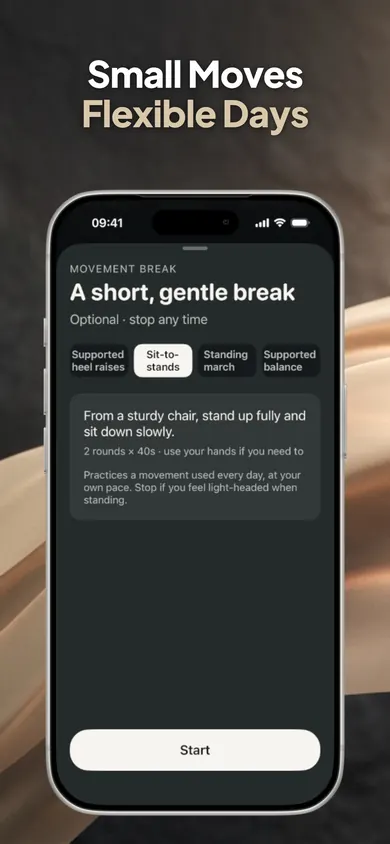
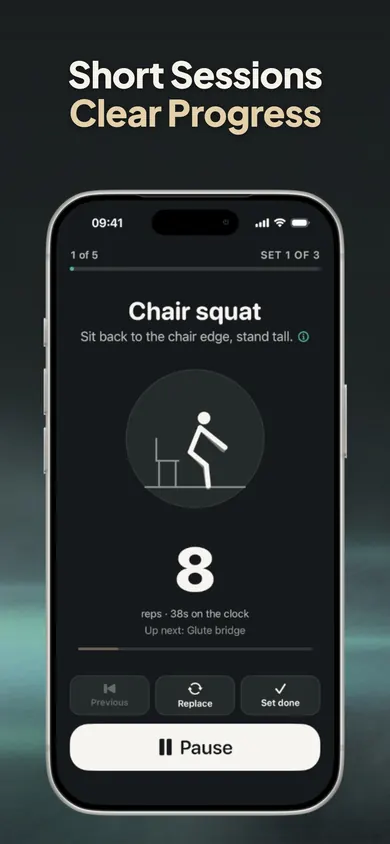
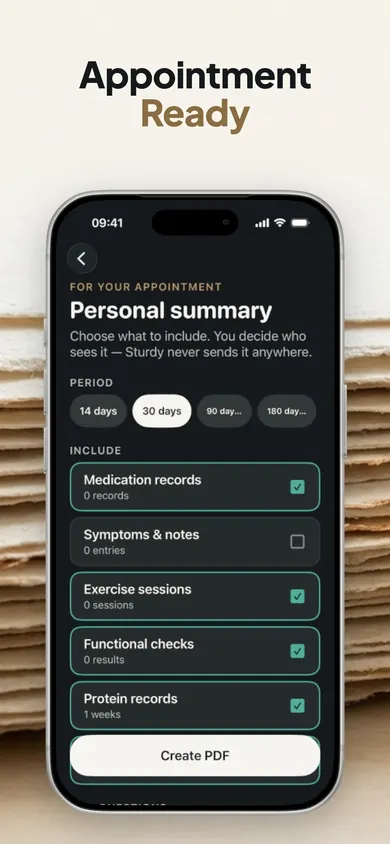
Sturdy builds a weekly plan from your days and equipment, runs guided sessions with a timer, swaps movements away from sore areas, records chair-stand check-ins and makes a 30-day PDF for appointments. Those parts are free; Sturdy Pro adds gym-equipment movements, longer sessions and longer progress views.
This is general information, not medical advice. Talk to your clinician.
Honest limits
- It is a starting point, not a prescription. We wrote the cards to be gentle and familiar, not tailored to your joints, heart or bones. A physical therapist can tailor them.
- Paper does not adapt. If your knee hurts on Tuesday, the card will not swap the move for you. Sturdy does that when you flag a sore area.
- Sturdy is not a medical app. It does not diagnose, treat or give medication advice, and its check-ins have no scores or age norms.
The same moves, in Sturdy
Your card and the free printable
Answer the three taps at the top and your card appears here.
Three pages, US Letter, one level per page, each with a 12-week tick grid and four chair-stand boxes. No email needed.
How to use the cards in 3 steps
- Print your level and set up once. A sturdy chair without wheels, pushed against a wall, next to a counter. Shoes on.
- Do the card on 2 or 3 days a week. About 15 minutes, never on back-to-back days at first. Tick a box each time.
- Test every four weeks. Count chair stands in 30 seconds with arms crossed, the CDC STEADI 30-Second Chair Stand (2017) method, and write the number down. Bring the sheet to appointments.
Prefer a coach in your pocket?
Sturdy turns these ideas into a weekly plan, guides each session with a timer, logs protein your way and keeps your chair-stand results private on your iPhone. No account.

Get Sturdy free on the App Store.
Related
- Sturdy: strength and protein on GLP-1Sturdy plans short strength sessions and logs protein for adults on prescribed GLP-1 medication. Private, no account, free on iPhone.
- Workout plan after stopping GLP-1: free 12-week printableTapering or stopping a GLP-1? Build your training week in 20 seconds, then print a free 12-week strength and walking log. No email needed.
- Your first workout after starting GLP-1 (free 5-minute timer)Just started a GLP-1? Build a gentle 5-minute first strength session for your knees and energy today, then run it with a free on-page timer.
- Finding a GLP-1 personal trainer near you: a 5-step vetting guideLooking for a personal trainer who understands GLP-1 medication? Verify credentials free, sort their answers, and know what to track between sessions.